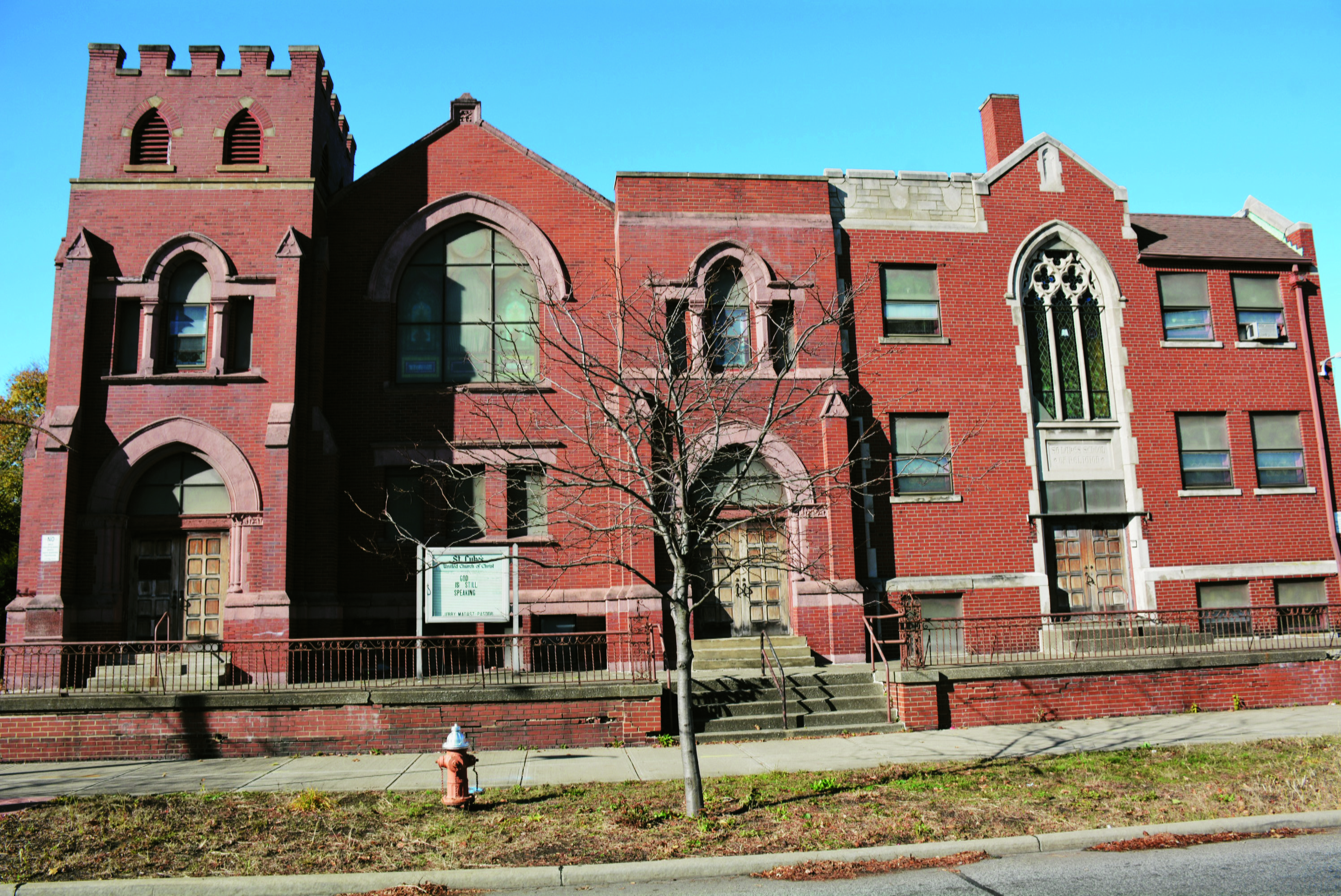
PHOTO BY CHUCK HOVEN
November 18, 2023, Pearl Road at Memphis Avenue: This former St. Luke’s United Church of Christ sits on the site of a proposed new development in the Old Brooklyn Historic District. The building was one of the key factors in the Historic District receiving its designation on the National Register of Historic Places.
by Lynette Filips
(Plain Press January 2024) The northwest corner of Pearl Rd. and Memphis Ave. which the Old Brooklyn Community Development Corporation (OBCDC) is seeking to “revitalize” with a $31 million new construction project is the most historic section of the Old Brooklyn neighborhood of Cleveland. It has been on the National Register of Historic Places since February 25, 2005, designated at that time as the “South Brooklyn Commercial District”. Pictured with the listing is St. Luke’s United Church of Christ, one of the numerous historic commercial and institutional buildings on Pearl Rd. (and Broadview Rd.) included in the Historic District designation.
While OBCDC pursues funding for a plan to tear down the major portion of this corner to erect a four-story building with commercial space on the first floor, residential space on the upper floors, and a brewery in the church proper portion of the former St. Luke’s, another group of people in the Old Brooklyn neighborhood are still hoping to “Save Our Historic District”
This is the first of what I hope will be a series of articles to shed light on what the legacy of downtown Old Brooklyn means to our neighborhood and why we feel that historic adaption of the existing buildings is superior to tearing down most of them and replacing the demo-ed area with new construction. Historic adaptation would accomplish the same goals of adding new residential space, updated commercial space and socialization space to downtown Old Brooklyn, but it would do so by using the existing historic structures. It is the method which has been employed in downtown Cleveland to put residential, hotel, and new retail and restaurant space in buildings which formerly housed department stores, banks and other businesses.
Because Pearl Rd. follows the path of a former Indian trail and, after the settlers arrived, became the Cleveland-Columbus-Cincinnati (CCC) Highway (the route which stagecoaches took between Cleveland, Columbus and Cincinnati), the thoroughfare has historically received a lot of traffic and attention. In prior years it has also been called the Turnpike Road, Pearl St. and Columbus Rd.
Memphis Ave., too, has been an important thoroughfare in the Old Brooklyn community. It was first called Mill St. because soon after the first settlers came to the “south of the Big Creek Valley” part of Brooklyn Township in 1814, a family of millers also arrived there in 1816. Sawmills and gristmills were essential to establishing a community out of the wilderness, and Jeremiah Gates was the man who made that happen. When he came to Brooklyn Township though, he initially worked with another miller.
Jeremiah Gates built his first water-powered mills around Harvard Ave., but then later in our “neighborhood.” One gristmill was on land where W. 39th St. and Muriel Ave. intersect today. Another was on the Gates property south of Mill St. and today’s Pearl Rd. Ultimately Jeremiah Gates built many, many mills.
In 1820 Jeremiah built the original portion of his lovely brick home which still stands at 3506 Memphis Ave. (on the hill where W. 35th St. ends in Memphis Ave.) It is the oldest home in Old Brooklyn, the bricks having been made from clay found in a nearby creek bed. According to the Cuyahoga County Auditor’s records, Efty Simakis has owned the property since 2003.
Jeremiah and his wife Phoebe had four children. Their son Reuben also became a miller but since he did most of his work in Parma, Reuben is not as important to Old Brooklyn as Jeremiah’s other son, Charles, who followed in his father’s footsteps closer to home. Charles built steam-powered mills (for grain and lumber, as well as fertilizer and paint) on the southwest corner of today’s Pearl Rd. and Memphis Ave. He also built a grand home on that corner (where CVS was until recently.) Charles’ mills and his house are long gone, having been replaced by storefronts which are also now gone.
Charles and his wife Mary had three children. Their son Lafayette lived in a house on today’s Memphis Ave., not far from where he worked at his greenhouse and florist shop. They were on Gates’ property close to today’s Pearl Rd. and Stanford Ave.
Charles and Mary Gates’ other son, Howard, was also a miller. In 1893 he established a mill and a grain elevator in the Big Creek Valley (next to the railroad tracks near today’s Cleveland MetroParks Zoo.) When it had to close due to construction of a new Brooklyn-Brighton Bridge, Howard built a mill and elevator on Broadview Rd.
Howard also built a grand home at 4248 W. 35th St., next door to Jeremiah’s. It is still standing, owned today by Koinonia Community Holding, LLC, and used as a group home for individuals with physical and/or mental challenges.
(If anyone is wondering if these men are members of the better-known Gates family – yes, they are. Jeremiah Gates and his brother Nathaniel later helped their brother Holsey set up a sawmill at a point on the Chagrin River in Mayfield Township which later became the Village of Gates Mills.)
In addition to their two homes, the Gates family’s presence in Old Brooklyn remains today in that they are buried in Brookmere Cemetery, literally around the corner from where they lived. There is a tall Gates monument at the end of the driveway into the Cemetery and the roadway circles around the resting places of many members of the family. The Cemetery is accessed from “Short” Broadview Rd., just west of Pearl Rd.
Interestingly, there is another cemetery involved in this saga of St. Luke’s and the “South Brooklyn Commercial District”. It was called the “Old Burying Ground Lot”, and it is reputed to have been the first public cemetery in the community that became the Brighton/South Brooklyn/Old Brooklyn part of Brooklyn Township (and eventually Cleveland.) It was located in the same area of which we are speaking — on the northwest corner of what became Memphis Ave. and Pearl Rd. It is the topic with which we will begin next month’s history article.
 Plain Press
Leave a comment