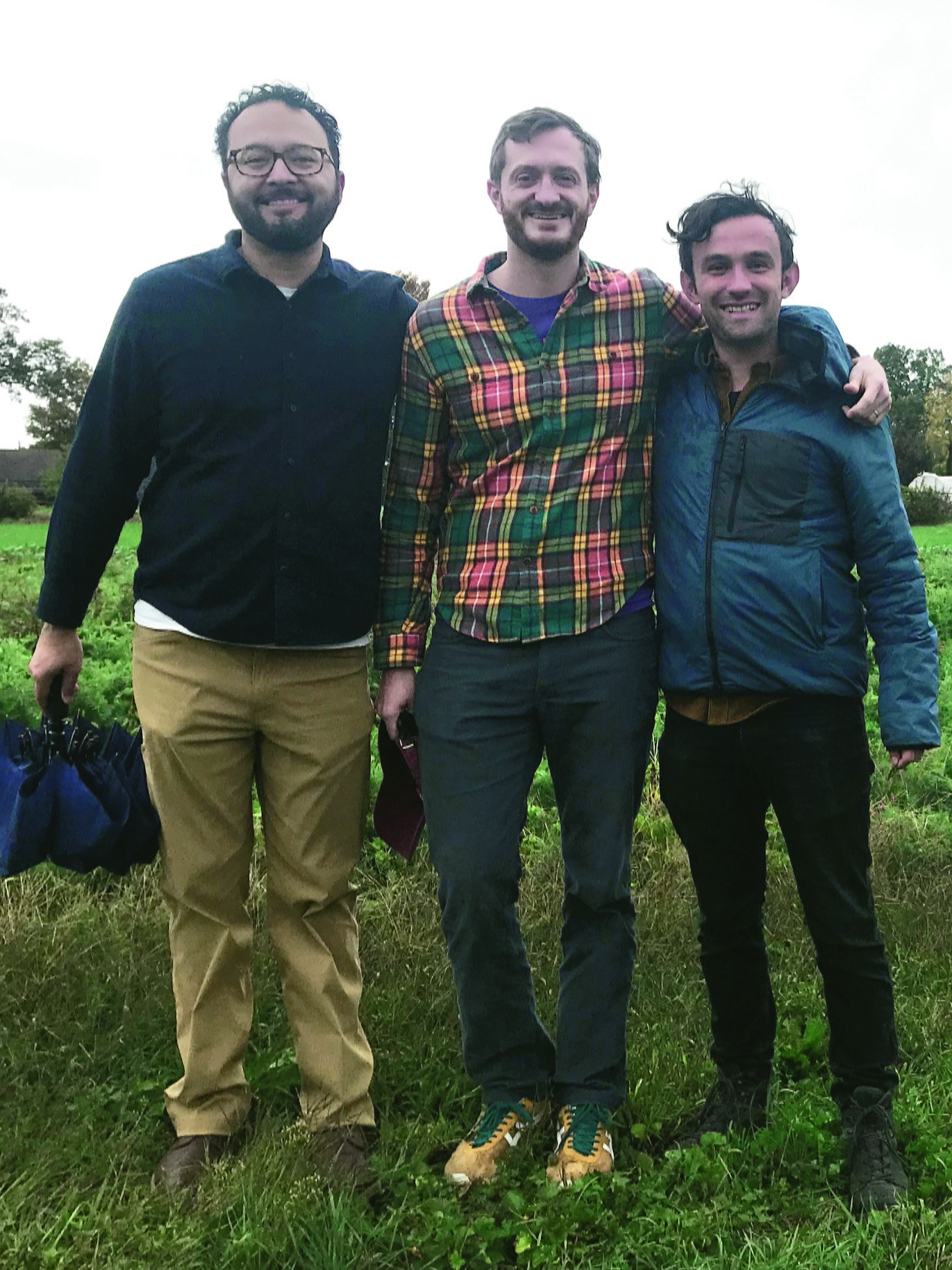
PHOTO COURTESY OF CLEVELAND OWNS
The Cleveland Owns team at a co-op farm in Cincinnati. (L to R) Craig Ickler, Energy Democracy Organizer; Jonathan Welle, Executive Director; and Bogdan Vitoc, Co-op Organizer.
by Bruce Checefsky
(Plain Press March 2024) Economic democracy proposes a shift of ownership and decision-making from shareholders and the board of directors to public stakeholders like workers, consumers, suppliers, communities, and the broader public. Former Chicago Mayor Lori Lightfoot made a historic commitment to the community wealth-building strategy last year by proposing, as part of her budget message, a $15 million community wealth-building pilot.
Working with the City of Chicago’s Office of Equity and Racial Justice, The Democracy Collective (TDC), based in Washington, D.C. and Cleveland, advised the city on community wealth-building strategies. Current Chicago Mayor Brandon Johnson has doubled down on the program since taking office in May 2023.
The Democracy Collaborative (TDC) defines community wealth building as a systemic transformation of local economies “to bring about shared prosperity, racial equity, and ecological sustainability through greater democratic ownership and participation.”
TDC has previously played a role in the Evergreen Cooperatives in Cleveland, a community-based economic revitalization program designed to build thriving businesses and vibrant local economies by creating quality jobs through a network of employee-owned enterprises in Northeast Ohio. The Evergreen Initiative proposes to reduce poverty and inequality by building community wealth, democratizing ownership, and creating local green jobs for residents of one of the high-unemployment, low-income neighborhoods.
No such program exists in the City of Cleveland, according to Jonathan Welle, Cleveland Owns Executive Director, an economic democracy incubator that builds cooperative businesses and leads campaigns for community control of resources.
“There were some smart investment moves the City of Cleveland made with the ARPA money, but as far as I know, none of it went to community wealth building,” said Welle, known most recently for leading Issue 38 People’s Budget, which would have given residents more power over the City budget. Cleveland City Council and labor unions pushed hard against Issue 38, narrowly defeating the charter amendment with 51 to 49 percent of the votes.
Cleveland Owns, incorporated as a 501(c)3 in 2019 and located at 4241 Lorain Ave., supports five cooperatives working in clean energy, food access, digital access, and collective purchasing. They work with grassroots groups to deepen their capacity to organize and develop businesses.
“We are an economic democracy. We incubate projects that build democracy in our economic system, mostly by starting cooperatively owned businesses that serve their members. We also focus on solar cooperatives to promote energy democracy,” said Welle. “We also do general organizing like the People’s Budget, plus co-op circles, which bring together co-ops from around the city. We know that ownership is the currency of power in our economy today.”
Cleveland Owns’ mission is to redistribute ownership equitably by creating democratically owned and controlled institutions, Welle added. “We are working on a purchasing co-op, where nonprofits come together to buy stuff in bulk.”
Individual home ownership has not traditionally been an area of focus for the organization, but cooperative home ownership with housing co-ops potentially is. In Cleveland, 75% of white households own their home, while home ownership in the black community is more like 33%. A limited equity cooperative (LEC) is a residential development owned and managed by a democratically governed, nonprofit cooperative in which residents purchase a share in a development rather than an individual unit and commit to reselling their share at a price that maintains affordability over the long term.
In 2023, the Cleveland Co-op Fund, started by Cleveland Owns, gave a loan to Rust Belt Riders, one of Northeast Ohio’s most established worker-owned composting services, totaling $450,000.
“We are incredibly excited about their mission,” Welle said. “That is just one of the ways we support existing co-ops, and we also support new co-ops through a program called Co-op U, a fourteen-week online incubator program.”
Co-op U provides hands-on coaching for people wanting to start a co-op. The program with Co-op Cincy and Co-op Dayton offers a replicable business model to develop a successful business plan, weekly meetings and personal mentorships, and an opportunity to access financing.
Cleveland Owns receives a mix of institutional financial support from local founders such as the George Gund Foundation, Cleveland Foundation, and Deaconess Foundation, as well as national support and grants, individual donations, and fees for service income like writing feasibility studies for a co-op.
Welle has worked with the City of Cleveland Office of Sustainability on a community-owned community solar project in the Hough neighborhood. Communities can produce electricity rather than purchase it from large utilities, which could democratize the clean energy transition.
The Hough Block Club, a community-wide initiative also known as The BC that launched in 2019, will administer the solar program and partner with Cleveland Owns to build an 11-acre, ~4-megawatt ground-mount community solar project that foregrounds equity. The project will use a “partnership flip” model where the organization will split costs with a yet-to-be-named solar developer, with an option to buy them out at the end of the agreement.
Once completed, Hough residents would be eligible to connect to the solar hub via subscription using virtual net metering, which is crucial to the future of community solar in Ohio. Welle sees the Hough initiative as a template for other community-based solar operations to generate economic prosperity and promote racial equity.
“We have a compelling vision and business plan for how that project would work. We have explored a couple of avenues for funding through private grants and investment opportunities like tax credits. Residents who want to be actual owners have an opportunity to invest through low-interest loans.”
The local City government has not invested in projects that promote community wealth like in other cities across the country, including Chicago, and Cleveland remains mired in a past unwilling to change, said Welle. Recent efforts to promote cooperatives and community wealth building in major U.S. cities have sprouted up in New York City; Madison, Wisconsin; Richmond, Virginia; Denver, Colorado; Minneapolis, Minnesota; Jacksonville, Florida; and Rochester, New York.
The People’s Budget Issue 38 laid the groundwork for community participation in economic democracy and helped shape the future. Welle cites that as a positive outcome.
“More people began to understand the power of economic democracy through the People’s Budget campaign. People want more democracy and power at the local level. They want more say over things in their lives. We have the tools to make that possible if we have the political will,” he said. “Now is the time to build an office of community wealth building in Cleveland.”
 Plain Press
Leave a comment