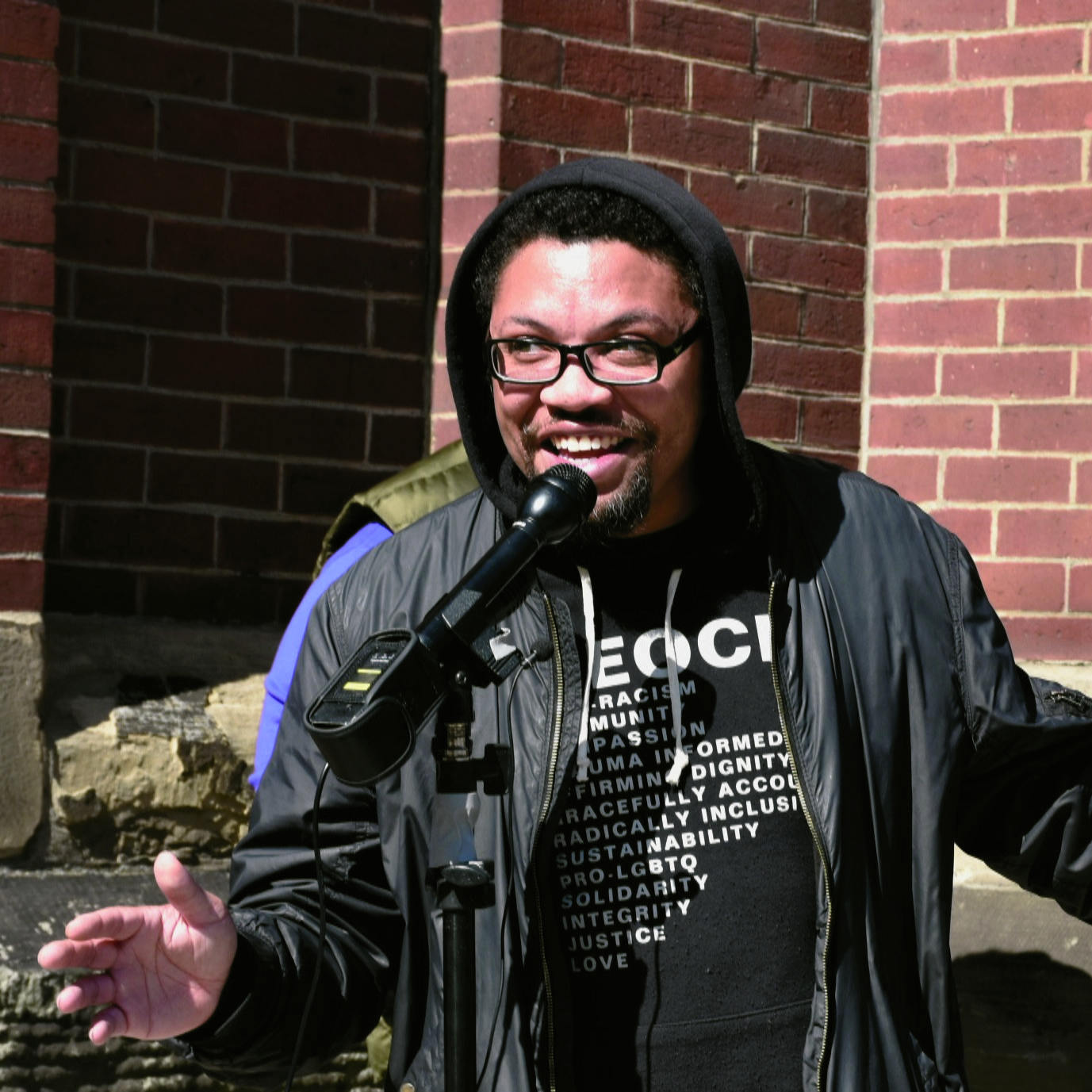
PHOTO BY CHUCK HOVEN
Monday, April 22, 2024; Northeast Ohio Coalition for the Homeless response to Supreme Court Case on homelessness, Franklin Circle Church, 1688 Fulton Road: Josiah Quarles, Director of Organizing and Advocacy for the Northeast Ohio Coalition for the Homeless, explains why advocates for the homeless are concerned about the Grants Pass vs. Johnson case before the United States Supreme Court.

PHOTO BY CHUCK HOVEN
Monday, April 22, 2024; Northeast Ohio Coalition for the Homeless response to Supreme Court Case on homelessness, Franklin Circle Church, 1688 Fulton Road: Kait McNeeley, Northeast Ohio Coalition for the Homeless (NEOCH) Deputy Director, says NEOCH is opposed to the criminalization of homelessness. She said penalizing people for being homeless would violate the 8th Amendment of the Constitution which forbids cruel and unusual punishment.
by Chuck Hoven
(Plain Press May 2024) Thirty Clevelanders responding to a call for a National Week of Action to oppose the criminalization of homelessness held a rally outside of Franklin Circle Church on Fulton Road on Monday April 22nd.
Homeless advocacy groups calling for the National Week of Action are the National Low Income Housing Coalition (NLIHC), the National Homelessness Law Center, National Coalition for the Homeless and the National Alliance to End Homelessness.
The call for the National Week of Action came in response to the United States Supreme Court beginning hearings on the case of City of Grants Pass, Oregon v. Johnson. A case that the Nation Low Income Housing Coalition calls it “the most significant case about the rights of people experiencing homelessness in decades.”
In describing the court case, NLIHC says, “The court will decide whether communities that failed to address the need for affordable housing and shelter can punish unhoused people for sleeping outside with tickets, fines and arrests, even when there are no other safe or adequate housing or shelter options available.”
The local action was organized by the Northeast Ohio Coalition for the Homeless (NEOCH). Josiah Quarles, NEOCH Director of Organizing and Advocacy, explained the Supreme Court case, called for local efforts to prevent criminalization of homelessness and urged action to insulate Cuyahoga County from the impact of a possible negative decision by the Supreme Court.
NEOCH Deputy Director Kait McNeeley said NEOCH opposes the criminalization of homelessness and instead calls for more compassionate response which includes increasing the availability of affordable housing and supportive services. She hoped the Supreme Court will rule that criminalizing homelessness is unconstitutional because it violates the 8th Amendment guarantee against cruel and unusual punishment. She said, if the Grants Pass challenge succeeds, people facing one of the most traumatic points in their lives would have their circumstances criminalized and force them into even more unsafe conditions.
NEOCH’s Advocate for Justice Strategy Mike Jones spoke of the barriers individuals who have a criminal record experience when applying for housing. He urged that those that have served their time should be given a second chance and not be subject to housing discrimination.
Pastor of Franklin Circle Church Rev. Richard Hinkelman urged following the example of Jesus Christ in bringing dignity to those whom society has shunned. He urged Clevelanders to “Do something for someone to affirm their dignity and humanity.”
Emily Collins, Senior Advisor to Cleveland Mayor Justin Bibb, thanked NEOCH organizers for inviting the City of Cleveland to participate in the rally. She said the City of Cleveland stands in solidarity with Cleveland’s homeless population. Collins cited the Home for Every Neighbor initiative announced by Mayor Bibb in February of this year. Collins said the “answer to homelessness is housing.” She said the City of Cleveland is looking at best practices in other cities and she said when adapting new models which she feels Cleveland must focus on housing.
In implementing its Home for Every Neighbor initiative, the City of Cleveland issued a request for proposals that were due in late March for partners who would help to implement the program.
A statement from the City of Cleveland outlines goals for the initiative:
The City hopes this new initiative will rehouse 150 or more unsheltered Cleveland residents within the first 18 months. Once fully implemented, the initiative aims to decrease transition time between unsheltered status and a successful permanent housing placement to 30-60 days, part of which will be accomplished via a “Housing Surge” process. The “Surge” is a 4–6-week process that will consist of various phases including a site assessment and inventory, initial stakeholder outreach to brief on responsibilities, multiple engagement sessions with unsheltered residents, and, eventually, a site clearance/rehousing schedule. The various stakeholders – including a project manager, outreach groups, landlord engagement team, transportation partners, first responders, and others – will have unique roles culminating in a “Surge” week, with the goal of getting unsheltered individuals into safe, stable housing as quickly as possible.
The City is hopeful, with external support, to increase housing options as well, which could include: • Building permanent supportive housing units, with at least 25 within the “safe haven” model. • Developing affordable housing units to meet specific needs of those exiting unsheltered situations, with low-barrier accommodations in place. • Development of a full season centralized Navigation Center that will serve as a specialized intake location for short-term crisis response with on-site health services to meet unique immediate needs, while also helping develop long-term sustainable housing plans upon exit
The City of Cleveland outlines the strategy it will employ to reach these goals:
The City’s strategy consists of four key components: • Engage – Adopting and implementing an intensive, tailored engagement strategy that will consist of deploying various street outreach teams to targeted areas to connect unsheltered residents with resources and emergency, temporary, or other short-term housing options. • Collaborate – Working with the County’s Office of Homeless Services, and other providers in the Continuum of Care, to facilitate information-sharing, jointly evaluate programs, and make improvements to services based on data-driven results. The City will also leverage public-private partnerships to obtain additional funding, build up programming, and improve workforce and educational opportunities. • Incentivize – Linking housing repair programs with landlord incentives as a recruitment tool to increase participation in rental assistance, utility assistance, hotel/motel vouchers, and other related programs. The City will also work with developers to ensure that certain criteria are met to make projects more accommodating to residents exiting unsheltered situations. • Build – Renovating existing facilities, rehabbing and converting repurposed buildings, and constructing new affordable housing units. The City will also explore ways to improve overall services that may be provided during the housing process (e.g. transportation, meal boxes, legal aid, case management, health provider options, childcare, etc.).
Editor’s Note: Those seeking shelter in Cuyahoga County can call 211 for assistance.
 Plain Press
Leave a comment