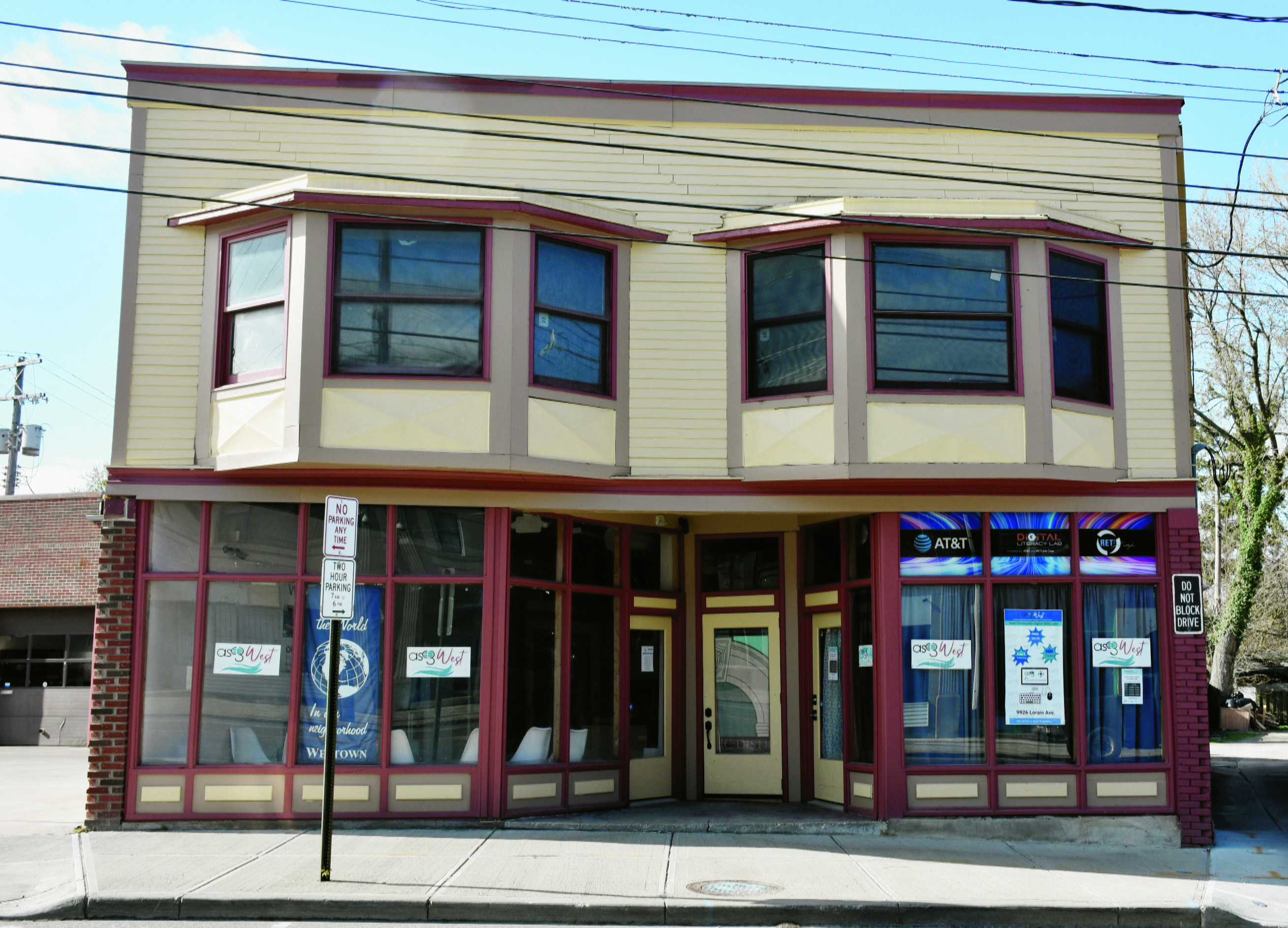
PHOTO BY CHUCK HOVEN
Saturday, April 20, 2024; 9926 Lorain Avenue: Ashbury Senior Computer Community Center (ASC3) and PC’s For People, housed at 9926 Lorain Avenue, joined with Westown Community Development Corporation to host a Digital Diversity Dialogue on April 24th.
by Chuck Hoven
(Plain Press May 2024) The Ashbury Senior Computer Community Center at 9926 Lorain Avenue hosted a Digital Diversity Dialogue luncheon on April 24th billed as “a gathering of thought leaders and organizations dedicated to advancing Digital Equity and Inclusion in Cleveland.”
Those in attendance came from a variety of nonprofit and government agencies. The speakers offered an update on Cleveland’s efforts to provide low-cost internet access to residents throughout the city. They also received an update on the failure of Congress to continue to fund the federal Affordable Connectivity Program through which 40% of Cleveland residents received internet access, often at no cost, due to a $30 monthly subsidy from the United States government. Residents signed up for the Affordable Connectivity Program’s internet access may start receiving bills within the next month. Those facing problems with continuing access can call the Digital Navigational Hotline at 216-307-6990.
Ashbury Senior Computer Community Center (ASC3) Executive Director Wanda Davis shared some of the history of ASC3 and its efforts to bring its services to the West Side of Cleveland. The organization which started on the East Side of Cleveland in 2002 has served over 9,000 students. It has helped 2,800 people to adapt to using broadband for the first time and has helped to provide 2,200 individuals with new or refurbished devices.
ASC3’s Board of Directors’ President Shaletha Mitchell said ASC3 is engaged in the “challenging but rewarding work of bringing Clevelanders into the digital space.” She stressed the importance of internet access in the digital age.
In its new West Side home at 9926 Lorain Avenue, ASC3 is sharing space with PCs for People, which has partnered with ASC3 for the past five years. PCs for People’s Director Bevin Bowersmith said the organization provides affordable devices for individuals that meet income requirements. The organization receives corporate donations of technology and offers a wiping service to remove the donor’s data from the devices.
ASC3 offers 8-week computer and internet skills classes and a free computer upon completing the classes. The organization also provides custom classes to meet the needs of various organizations.
Rose Zitiello, Executive Director of Westown Community Development Corporation offered a little history of the Lorain Station neighborhood where the ASC3 office is now located. She stressed the importance of the work that ASC3 ad PCs for People were doing in the neighborhood and told those in attendance that Westown would be moving to the upstairs of the building at 9926 Lorain Avenue on May 1st.
Director of Connecting Your Community Bill Callahan shared some of the history of introducing neighborhood residents to using computers. As Executive Director of the Stockyard Area Development Corporation in 1994 operating out of the old Gilbert School Building on W. 58th in the Stockyard neighborhood, Callahan said the federal government was implementing the Welfare to Work program and many residents were being told they needed computer skills, specifically being able to use a spreadsheet to get a job. To help, Callahan said Stockyard Area Development Corporation began to obtain donations of computers, offering 10 hours of computer classes and a computer for residents to take home for $40.
Callahan noted that now, 30 years later, the 44102-zip code, in which he worked in in 1994 and that ASC3 now has its office located, is on the top of a national list of areas where there are high numbers of residents without internet access. He said 44102 has about 19,000 households and about 7,000 of those households have no desktop or laptop computer in the home. An equal number don’t have internet access, he said. Callahan emphasized that the task of bringing people into the digital age “is not one of those things where you can say let’s do a program and we will have it fixed.”
City of Cleveland Digital Inclusion Manager Ricardo Reinoso spoke of the City of Cleveland’s use of federal Emergency Broad Band funds provided through the federal Affordable Connectivity Program to partner with the nonprofit organizations to help residents access the internet. He said the City of Cleveland is also using $20 million in American Rescue Act program funding to work with Digital C to provide fiber and low-cost internet to every block in the City of Cleveland. He said by June of 2025, Digital C should be rolled out citywide. Reinoso said that City of Cleveland plans call for replacing all computer labs in Cleveland recreation centers with new ones by next year. He suggested that on days when the recreation centers are being used as heating or cooling centers because of weather conditions, the City should open the computer labs for 24-hour use.
Cleveland Foundation Chief of Technology and Platform Solutions Leon Wilson said he sees improving digital access for residents as a three-legged stool: access to affordable devices, digital literacy training and affordable broadband internet. When he met folks from PCs for People in St. Paul Minnesota, he asked what it would take to get them to come to Cleveland. He also noted that Cleveland is lucky to have two nonprofit internet service providers – Digital C which has the contract to connect most of Cleveland to the internet for $18 a month, and PCs for People which already has a contract providing the Old Brooklyn neighborhood with internet access for $14 per month.
Director of Community Outreach and Education for Digital C Ladonna Norris said that engineers working for the program say they are ahead of schedule and are confident that the entire City of Cleveland will have access to high quality internet for $18 per month within the next 14 months. Norris said she is a resident of 44102 and will be signing up for the $18 a month internet service as soon as it gets to her street. She said she is currently paying $80 a month for internet service. Norris said residents can text, call or email Digital C to see when their block will be getting service. She said you can even sign up to get contacted when your neighborhood has access. Digital C’s phone number is 216-777-3859. The Digital C website is www.digitalC.org
Cleveland Metropolitan School District (CMSD) Information Technology Officer Curtis Timmons said during the pandemic CMSD was able to provide 20,000 computers to our students and created hotspots in the community for families that didn’t have internet access in their homes. Timmons expressed concern that there wasn’t a sustainable model for keeping the households where students live connected to the internet. He said, the money that allowed families to connect to the internet has dried up already.
Speakers at the Digital Diversity Dialogue offered resources that residents and community organizations can explore to learn more about efforts to close the digital divide in Cleveland. Some of the resources to explore are Connect Your Community’s website at: www.connectyourcommunity.org. The site offers updates on news about efforts to provide digital access. Greater Cleveland’s online digital skills learning site: https://.cleveland.digitallearn.org The National Digital Inclusion Alliance that has a list serve, offers information on digital advocacy efforts and can help answer questions such as the availability of digital learning classes in other languages at www.digitalinclusion.org.
Leon Wilson of the Cleveland Foundation urged organizations or individuals interested in getting involved in closing the digital divide in Cleveland to get involved with the Greater Cleveland Digital Equity Coalition. He described the organization as a loosely managed group that comes together to discuss national, state, and local policies related to digital access.
 Plain Press
Leave a comment