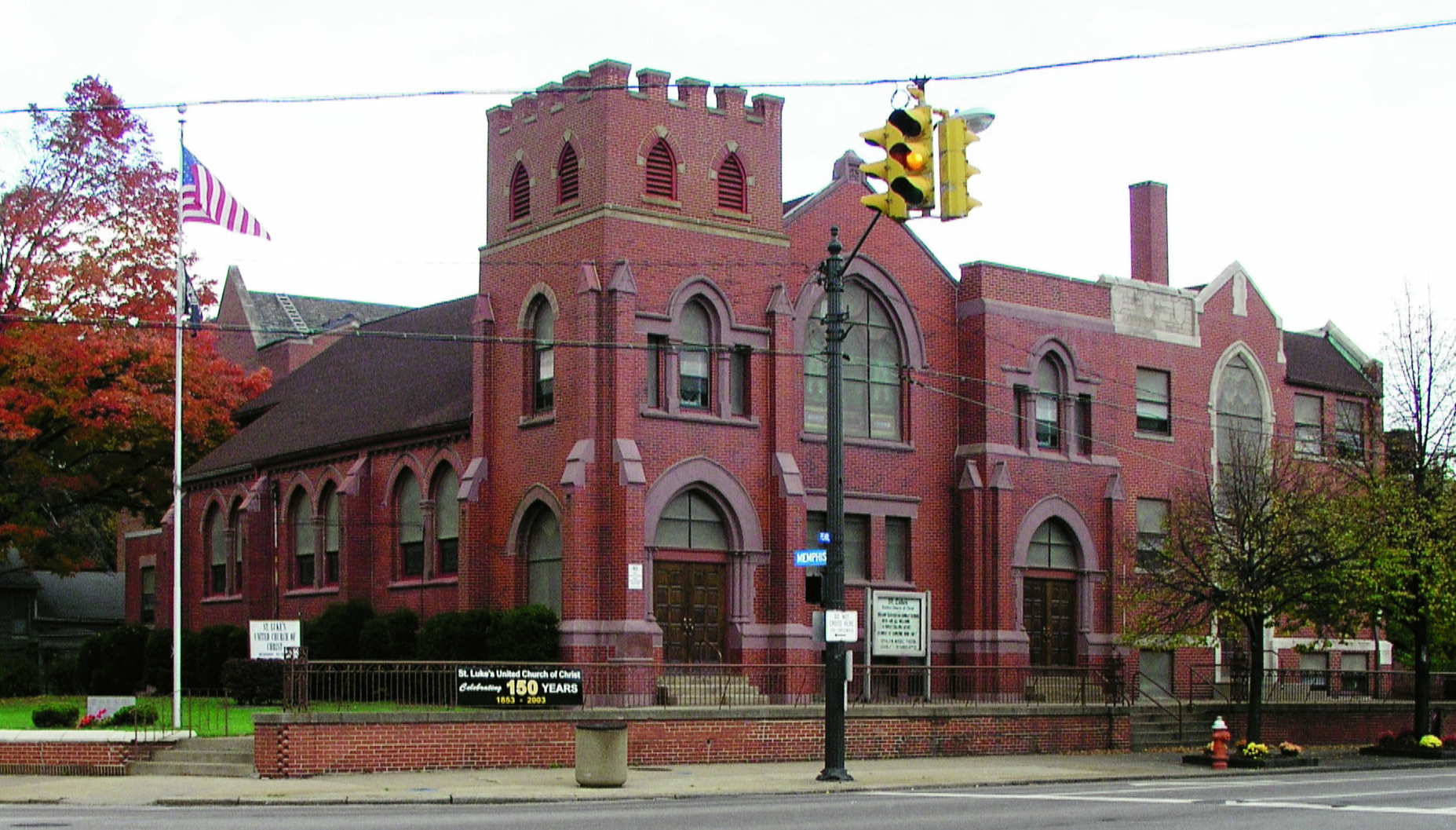
PHOTO COURTESY OF OLD BROOKLYN NEWS
Photo from November 2003 issue of the Old Brooklyn News: this photo of St. Luke’s United Church of Christ, at Pearl and Memphis, accompanied an article by Lynette Filips that marked the celebration of the 150th Anniversary of the congregation.
by Lynette Filips
(Plain Press June 2024) This month we continue to look at the history of the northwest corner of Pearl Rd. and Memphis Ave. which the Old Brooklyn Community Development Corporation (OBCDC) is seeking to “revitalize” with a $31 million new construction project. It is the most historic section of Cleveland’s Old Brooklyn neighborhood and has been on the National Register of Historic Places since 2005. A picture of St. Luke’s United Church of Christ, one of the numerous commercial and institutional buildings on Pearl Rd. (and on Broadview Rd.) included in the Historic District designation, accompanies the online listing of the South Brooklyn Commercial District.
While OBCDC pursues funding for a plan to tear down the major portion of this corner to erect a four-story building with commercial space on the first floor, residential space on the upper floors, and a brewery in the church proper portion of the former St. Luke’s, another group of people in the Old Brooklyn neighborhood is still hoping to Save Our Historic District.
This sixth in a series of articles will shed additional light on the history of downtown Old Brooklyn in the hope that someone in authority will realize that adaptive reuse of the existing buildings is superior to tearing down most of them and replacing the demo-ed area with new construction. Adaptive reuse would accomplish the same goals of adding new residential space, updated commercial space, and new socialization space to downtown Old Brooklyn, but it would do so by using the existing historic structures. It is the method which has been employed in downtown Cleveland to put new residential, hotel, retail, and restaurant space in buildings which formerly housed department stores, banks, and other businesses.
In the first of the five previous articles, I wrote about the legacy of three generations of the Gates family of millers in Old Brooklyn. Jeremiah, the patriarch, arrived in Brooklyn Township in 1816. He built the original portion of his brick home at 3506 Memphis Ave. in 1820. It is the oldest home in Old Brooklyn and is a City of Cleveland Landmark. Jeremiah’s son Charles’ home has been demolished, but his grandson Howard’s home at 4248 W. 35th St. is still standing. Since they are residential rather than commercial buildings, they aren’t included in the National Register’s Commercial District, but they are important components of the area’s historic nature.
In the second of the five previous articles, I wrote about the precursor of Pearl Road United Methodist Church. It was located on the north side of the Big Creek valley where, at approximately the same time, many settlers with the surnames Fish and Brainard (as well as other names) had been settling. In 1814, a group began meeting in each other’s homes for classes in Methodism and in 1818 they organized as Brooklyn Methodist Episcopal Church. It was the first official congregation in Brooklyn Township and the first Methodist congregation in the entire Cleveland area.
In the third of the five previous articles, I wrote about Brighton Methodist Episcopal Church, the initial name of the first Methodist Church south of the Big Creek valley. The Methodist settlers south of Big Creek wanted a church on their side of the valley and in 1844 they purchased an existing building in the community and founded Brighton Methodist Episcopal Church. Their surnames included Brainard, Fish, Gates, Hinckley, and Chester. The Methodist Episcopals dedicated a new church building in the grassy area (in front of today’s Pearl Road United Methodist Church) in August of 1897. That space was remodeled in 1924, soon after a Department of Religious Education had been erected behind it. Everything was dedicated in November of 1924 but in February of 1925, the church was destroyed by fire. It was never rebuilt.
In article three I also began to write about the (Old) Burying/Burial Ground which was located at the corner of Pearl Rd. and Memphis Ave just south of the Methodists’ property. A very early cemetery, it was referred to as an Indian Burial Ground in Kathryn Gasior Wilmer’s book, Old Brooklyn New, Book II, written in the early 1980s for the Old Brooklyn Community Development Corporation. (Perhaps the cemetery originally was an Indian burial ground, but we do not currently have any official documentation about that.) In April of 2022, Historical Society of Old Brooklyn president Constance “Connie” Ewazen contacted local historian William G. “Bill” Krejci because Buried beneath Cleveland; Lost Cemeteries of Cuyahoga County isamong the ten books he has authored/co-authored.
In the fourth of the five previous articles, I wrote more specific information about the (Old) Burying/Burial Ground which I’d gleaned from Bill Krejci. He’s been researching this former burial ground for another book he’s working on and is sharing his research with me for this series. Thanks to Bill I could report that the (Old) Burying/Burial Ground ran along today’s Memphis Ave. to the end of today’s Greenline Building; then behind today’s St. Luke’s church building to the side wall of St. Luke’s educational annex; then along the sidewall of St. Luke’s educational annex to today’s Pearl Rd.; and then along Pearl Rd. back to Memphis Ave. Bill also supplied me with the names (and dates of transfers) of all the owners of the property on which this first public cemetery in Brighton was located, beginning with Warren Young on whose farm the cemetery land was originally, and ending with the Western Reserve Association of the United Church of Christ (in May of 2013).
In the fifth of the five previous articles, I wrote more about the Old Burying/Burial Ground. When it closed in 1836 (at the time of the establishment of nearby Brookmere Cemetery), the deceased interred in the Old Burying Ground were to have been exhumed and reburied in Brookmere. Based on his headstone research at Brookmere, Bill Krejci gave me the names of people who’d obviously been reinterred there and people without headstones who are recorded as having been buried at Brookmere.
Bill’s biggest concern, though, is whether the bodies of anyone interred in the Old Burying/Burial Ground were left there rather than being moved to Brookmere Cemetery. Based on his research he believes that the body of a veteran of the Revolutionary War named Richard Cooper remains in the cemetery on the northwest corner of Pearl Rd. and Memphis Rd. Other bodies may remain there as well. He will share his findings about our Old Burying/Burial Ground in one of his future books about Cleveland cemeteries.
This month I’ll be discussing the history of St. Luke’s United Church of Christ (including the congregation’s precursor which had a different name). I researched most of the information for an article I wrote for the November 2003 Old Brooklyn News. It was in honor of St. Luke’s celebrating 150 years at 4216 Pearl Rd. (at the corner of Memphis Ave.) on Sunday, November 16th, 2003.
St. Luke’s present church building isn’t 171 years old now, however. It was built in 1903-04, having replaced a wooden church which was erected by the German immigrants who started the congregation in 1853. And the congregation’s roots in Old Brooklyn (Brooklyn Township at the time) actually go back more than that. First known as the German United Evangelical Protestant Church of Parma, they were organized on August 11, 1839. In 1841, they spent $20 to purchase a schoolhouse located on the Brainard farm at Broadview Rd. and W. Schaaf Rd. With another $60 they refashioned it into a worship space, and the following year dedicated it as their first church building.
Due to the large number of people who were emigrating from Germany to Cleveland in those years, by 1853 the parishioners had outgrown their schoolhouse church. The majority wanted to relocate to the center of what was then unofficially called Brighton.
Because the membership was divided on the relocation issue, those who wanted to move seceded from the Broadview-Schaaf congregation, paid $100 for a parcel of land at the corner of today’s Pearl Rd. and Memphis Ave. (then Pearl St. and Mill St.) and erected a frame church. They called themselves the German United Evangelical Church of Brighton, and it was the 150th anniversary of the formation of the “new” congregation which St. Luke’s was celebrating in 2003.
History has a way of repeating itself, and again the church population was growing so quickly that the original building could not adequately accommodate them, and they again decided to build a bigger church. The brick structure cost $23,000, and it was an architectural gem both inside and out. In the Old Brooklyn Community Development’s current plan for the revitalization of the Pearl-Memphis corner, St. Luke’s sanctuary will remain.
St. Luke’s educational building, known as the “Annex”, was constructed in 1925 and cost an additional $57,000. An auditorium/parlor was on the first floor, classrooms and offices were on the second floor, and a kitchen, dining hall and gymnasium were in the basement. Sliding stained glass doors separated the auditorium/parlor from the church, and over the years that area functioned both as extra space for overflow crowds at services and as a fellowship room following the services. In the Old Brooklyn Community Development’s current plan for the revitalization of the Pearl-Memphis corner, St. Luke’s educational annex will be demolished.
Perhaps St. Luke’s most outstanding feature is its stained-glass windows. They are explained (and some are also pictured) in Kathryn Gasior Wilmer’s book, Old Brooklyn New, Book II, copies of which are still available for purchase at the Historical Society of Old Brooklyn Museum, for $5.50. The Museum is located at 3430 Memphis Ave. and is usually open on Tuesdays, Thursdays, and Saturdays from noon to 5 p.m. But if you want to stop by, call (216) 337-8200 to check and be sure.
In earlier decades of the last century, several hundred children were enrolled in St. Luke’s Sunday School classes. Even after attendance dwindled, the second-floor classrooms were still used for Sunday School. They were also rented to Old Brooklyn Montessori School during its first four academic years, beginning in August 1998.
A parsonage was also part of St. Luke’s past. A house which the church purchased at 3422 “short” Broadview Rd. (where Family Dollar is now) served that need from 1880-1904. Then St. Luke’s built a new parsonage at 4229 W. 35th St., just north of Memphis Ave. Approximately seventy years of pastors and their families called it home before it was sold in the mid-1970s.
Other changes St. Luke’s witnessed during its long life include: in 1929, the widening of Pearl Rd., which took several feet off its frontage; in 1935, discontinuing the use of the German language during worship, except on Holy Thursday; in 1953, eliminating that final Holy Week vestige of the vernacular; in 1947, establishing an endowment fund; and, in the early 1960s, redesigning the church sanctuary.
The church history books I read did not indicate when or why the congregation placed itself under the patronage of St. Luke. But based on the cemetery title transfers which local historian Bill Krejci researched (as reported in my article in the April 2024 Plain Press), it seems that it took place in 1925. A series of mergers among Protestant religions resulted in the Church’s name changing from St. Luke’s Evangelical Church to St. Luke’s Evangelical – Reformed Church to St. Luke’s United Church of Christ.
In the years when the churches were the social as well as the spiritual centers of the community, St. Luke’s had a very busy calendar. The Consistory (Church Board), Women’s Guild, Men’s Brotherhood, Choir and Sunday School were once much larger than they were in the final years. In earlier years St. Luke’s also had a Quilting Circle for the ladies, Teeners and a Lily Circle for teenage girls, a Youth Fellowship for both sexes, and a group for married and/or single younger adults. Church members also played on their own bowling, softball, and basketball leagues.
Because it was founded by the same religious organization, the goings-on at Deaconess Hospital (now MetroHealth’s Old Brooklyn Campus) were also of particular interest to the members of St. Luke’s, and some of Deaconess’ chaplains also preached from St. Luke’s pulpit.
St. Luke’s last pastor, Rev. Jerry Madasz, came to the congregation late in 1999 from a previous assignment in Grand River. I will pick up with the St. Luke’s final years, as well as move on to the history of some of the other Pearl-Memphis neighbors (commercial, residential, and institutional), in next month’s article.
 Plain Press
Leave a comment