PHOTO BY CHUCK HOVEN
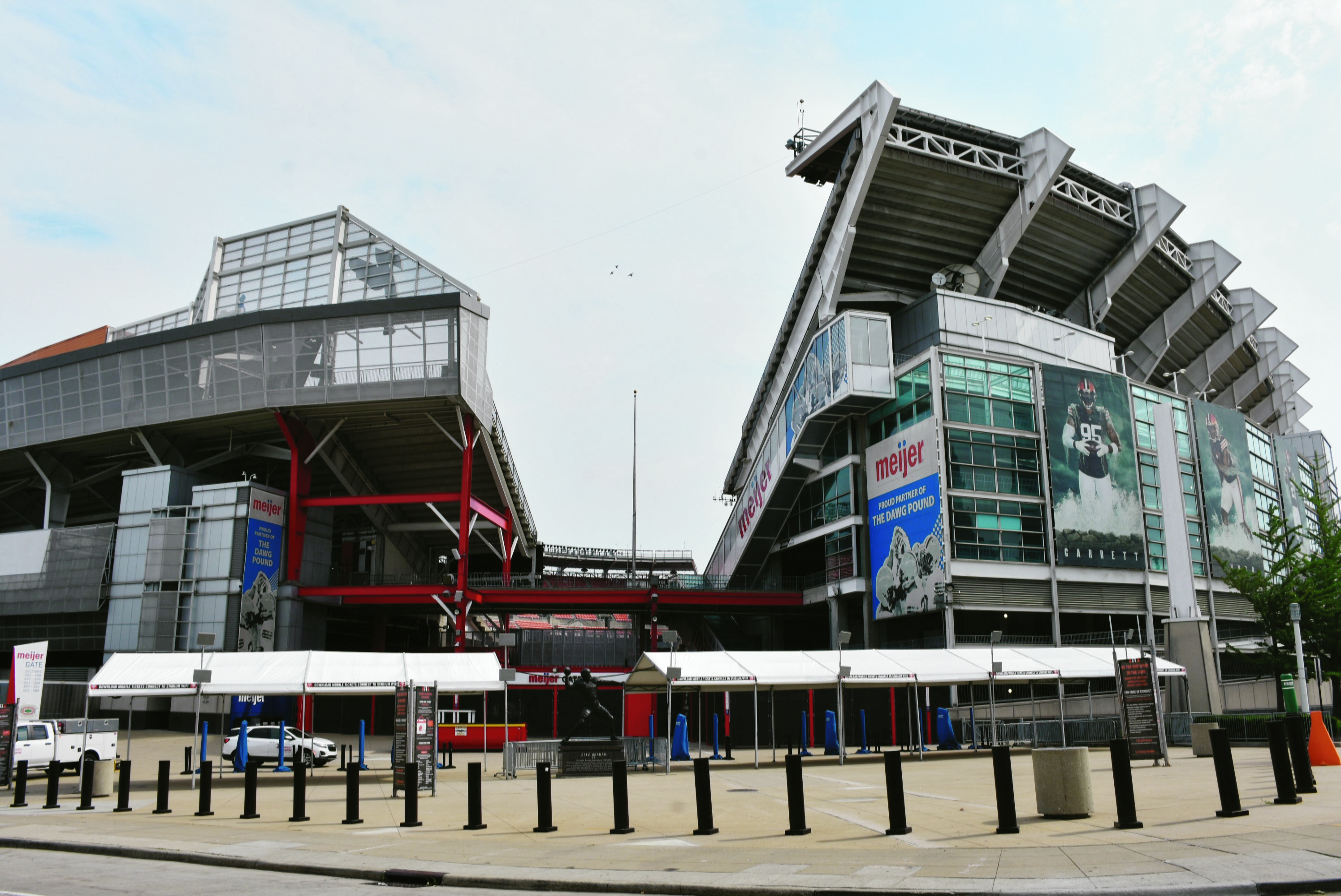
Wednesday, June 19, 2024; Cleveland Stadium, W. 3rd and Alfred Lerner Way: At a June 20th Panel Discussion, moderated by Ward 16 Cleveland City Council Representative Brian Kazy, speaker Ken Silliman, who represented the City of Cleveland in previous negotiations on stadium funding said, citing an Osborne Engineering Company study, “the stadium is in pretty good shape.” He said there is no need to spend massive amounts of public money on substantially rehabbing the current stadium or building a new stadium.
by Chuck Hoven
(Plain Press July 2024) A panel discussion on the economic impact of public financing of sports facilities was held on June 20th at the downtown Cleveland Public Library. Ward 16 City Council Representative Brian Kazy moderated the discussion. The panel included two economists Brad Humphreys of West Virginia University and Victor Matheson of the College of the Holy Cross. Ken Silliman, a top staff member in both Mayor Michael White administration and Mayor Frank Jackson administrations and the former chair of the Gateway Economic Development Corporation, was also on the panel.
Silliman argued that the current Browns stadium is in “pretty good shape.” He said there was a major overhaul in 2014. Also, unlike when the Brown’s threatened to leave the city in 1995, the owners of the team are not cash poor and there is no competing city seeking to take the team out of state.
NEWS ANALYSIS
In the discussion it was noted that the Haslams purchased the Browns for $1 billion dollars in 2012 and the team is now worth $4.5 billion. The capital gains alone would pay for any new stadium. Yet word is that the Haslams would like the public to pay for half of either a $1.2 billion major renovation of the current stadium or a $2.4 billion new domed facility in Brook Park.
The economists noted that stadiums don’t generate enough public tax revenue to make up for the public subsidies they are requesting.
Panel members also warned of tactics of league owners. The pattern is for league owners to try to create internal or external credible threats. One panelist said that, if the team owners say another city is offering a home for the team, ask them to name the city and how much of a stadium subsidy they are offering.
Victor Matheson said the ideal way to pay for a stadium would be for the users of the venue to pay for it. Estimates cited at the discussion indicate that about 70% of fans that attend downtown sporting events come from outside of Cuyahoga County. Matheson also noted that taxpayers don’t like to give money to billionaires. He said even in Kansas City where the Chiefs have won the last two Super Bowls, the voters have rejected public subsidy for a stadium.
Brad Humphreys talked about who controls the narrative concerning the building of a new stadium. He said that local media often push a narrative that is in favor of the team owners and public subsidies. He noted the Plain Dealer has a sports page and the TV stations don’t want to lose access to the teams that are a major part of their news coverage.
Silliman suggested that the focus should be on Congressional action to limit the monopolistic behavior of sports leagues that allow them to pit city against city.
Kazy noted that instead of pitting Cleveland against Baltimore, this time around the owners are pitting Cleveland against Brook Park. Silliman said that if the Browns moved to Brook Park, they would be abandoning a perfectly functioning stadium and leaving the City of Cleveland to pay for the cost of demolishing it.
While the narrative being pushed by the team owners in the media is a choice between a substantially renovated stadium downtown or a new domed stadium in Brook Park, Silliman offers a third option – keeping and maintaining the current stadium.
A statement by the Cuyahoga County Progressive Caucus, People’s Budget Cleveland and Cleveland Jobs with Justice that was handed out to those attending the meeting said that “sports facilities are poor public investments.” It noted they “don’t create new economic activity, just reallocate existing spending for entertainment, don’t boost overall employment and don’t increase local tax revenue.”
Responding to an audience member’s mention of the stadium tax exemptions for Gateway and the Browns Stadium, Silliman said that while it would have been nice to have property tax revenue for the school system, there was a critical shortage in funding for Gateway and the property tax exemption passed by the state legislature helped make the project work.
Silliman also responded to inquiry about the three taxes (parking, admissions, and motor vehicle leasing taxes) passed in 1995 by Cleveland City Council to provide money for both extracurricular activities for the Cleveland Metropolitan School District and annual allocations to the Browns stadium for repairs, improvements, and maintenance. While White promised $2 million per year to the schools for extracurricular activities, the Jackson administration reduced that to $1 million a year in 2011. Silliman said that in 2011 the City of Cleveland was dealing with the budget shortfalls due to a recession in 2011, and the State of Ohio was cutting the local government fund, so the funds were needed to shore up the budget.
In both instances cited by Silliman, the Cleveland school children took the budgetary hit rather than the billionaire owners of the Cleveland Browns. Cleveland City Council has done nothing to restore the funding to the extracurricular programs, and the Browns continue to get about $15 million a year from the same three taxes for maintenance, improvements, and repairs to the existing stadium.
 Plain Press
Leave a comment