
PHOTO BY BRUCE CHECEFSKY
Monday, December 30, 2024; Fix the Map Citizen Rally at Shaker Square: Theodore Wadell and Diab Dar-issa protest the proposed new City Council Ward maps that would radically change the ward boundaries in their Ward 15 and Ward 11 neighborhoods.
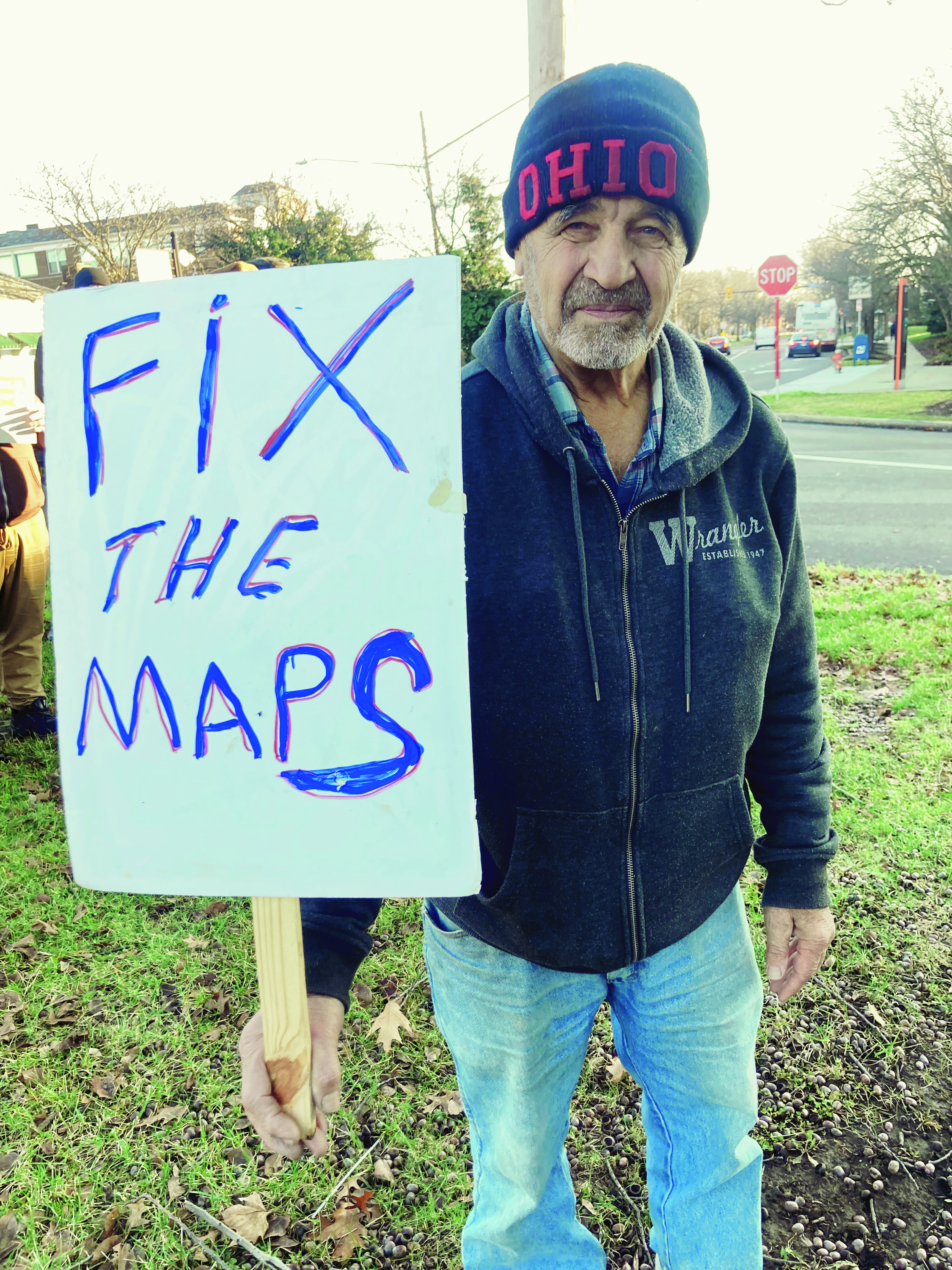
PHOTO BY BRUCE CHECEFSKY
Monday, December 30, 2024; Fix the Map Citizen Rally at Shaker Square: Faouzi Badeour opposes the proposed new City Council Ward map that he says will rip up the Cudell neighborhood he has called home for 47 years.
by Bruce Checefsky
(Plain Press February 2025) Faouzi Badeour, a resident of the Cudell neighborhood, was standing in Shaker Square in the below-freezing temperature holding a protest sign that read “Fix the Maps”. It was just a few minutes past 5:00 p.m., and commuter traffic was heavy. Some drivers honked their horns to support the Cleveland protesters. Others drove by, seemingly uninterested.
Badeour said they have been fighting with the city for over eighteen months over the remapping of wards. “This City Council [president] has been ripping apart the community to serve the interests of his loyalists at the City Council, including Danny Kelley. Everyone knows who his loyalists are.”
He was referring specifically to the breakup of several longstanding wards. The new redistricting plan reduces the City’s current 17 wards to 15. Ward 12, represented by Rebecca Maurer, is divided into several wards, and combined with others. She has been an outspoken opponent of redistricting, urging her fellow council members to let the people decide.
“The community must stay intact,” added Badeour. “I have lived in the Cudell neighborhood for 47 years, and they are ripping it apart along with Slavic Village so that his loyalists can become City Council members. I raised my three kids and my grandchildren in the Cudell neighborhood. It is my home.”
Theodore Waddell and Diab Dar-issa stood shoulder to shoulder with signs that read “Fair Maps No Gerrymandering” and “Blame Griffin”. Waddell, from Ward 15’s Eco Village, had a wool cap pulled over his ears. Dar-issa, a resident of Ward 11’s West Boulevard neighborhood, had a hooded sweatshirt jacket zipped up to his neck. Both men wanted politicians to know that the community is about people, not just lines on the paper.
“Real lives are impacted so much more than people realize,” said Dar-issa. “We hope to bring attention to that.”
Badeour leaned in. “One more thing,” he said. “Maybe Blaine Griffin will be surprised with what we do. We may fail with him, but we will take the issue back to the people in a referendum like in 2008. We will not give up.”
Council Member Maurer was circling the protestors about to address the crowd. “I support residents having their voices heard. When I heard they were organizing an event about the maps, I wanted to be part of it,” she said.
Politicians should not be drawing the maps, Maurer continued, referring to the failed initiative Issue 1 that did not pass the voters last November. “We are all Democrats at City Council. We believe this at the State House. I don’t know why we wouldn’t believe in it ourselves.”
Issue 1 would have created the Ohio Citizens’ Redistricting Commission, including 15 members: 5 from the largest political party, 5 from the second-largest political party, and 5 independents, and would oversee drawing district boundaries used in elections. It failed by a significant margin in the 2024 General Election.
Architect David Ellison, a former Green Party candidate for Cuyahoga County Executive and an Ohio City resident, complained about the redistricting process and wishes the City could find equity in representing its neighborhoods.
“I want the City wards to make sense in terms of neighborhoods and communities and have this process be less about politics,” said Ellison. “I would like to see the City Council function better and be less petty. Who benefits from this pettiness and partisanship? Lobbyists, bankers, and lawyers are behind it, as well as real estate developers. I want the Council to represent the people rather than the lobbyists, many of whom do not live in the city, anyway.”
Former City Council member Jay Westbrook was among the guest speakers. Westbrook, Council President from 1990 to 1999 and who served the Cleveland community for over 35 years, said his life in politics and community organizing led him to support the protest. “Strong communities get built from organized communities and politics responsive to community needs. Regardless of income, environment, and other serious obstacles, you can always take a stand,” he said. “I went through four redistricting processes during my tenure at City Council. You need a diligent effort to keep historical neighborhoods intact and new, emerging neighborhoods as contained as possible.”
Westbrook, a quality housing advisor volunteer for the Morelands Group of the Shaker Square community, said ward boundaries should be the glove that fits the hand. “I was a victim of redistricting. I am not naïve in understanding the process. This is a tragic lost opportunity.”
Other speakers included Matthew Ahn, a former candidate for the Cuyahoga County Prosecutor. Ahn lost the election to Michael O’Malley in a highly contested election. “I think it’s important for maps to represent our community rather than protect income subsidies,” he said. “We just went through an entire statewide campaign about the idea that politicians will always go to draw the maps for their benefit.”
Ahn predicts another charter amendment in 2028 to address the issues of inequity in the current iteration of the ward redistricting. “I don’t know that we have another option.”
Nearly an hour after the rally began, following an introduction by event organizer Nikki Hudson and after several speakers addressed the protestors, a round of applause broke out. The crowd quietly dispersed into the cold night.
On January 6, City Council voted to support new ward maps in a 14-2 majority. Ward 12 Council Member Rebecca Maurer and Ward 16 Council Member Brian Kazy voted against the redistricting measures. Ward 15 Council Member Jenny Spencer was not in attendance at the meeting.
In a press release issued by Cleveland City Council Communications later that evening, their message was brief. “Council approved a new 15-Ward map. The City Charter mandates the City use Census data to determine how many members will be seated on the City Council. As of the 2020 US Census, Cleveland has a population of 372,624 people, compared to 396,815 people in the 2010 US Census—a 6.10% decline over ten years.”
Council president Blaine Griffin has not spoken publicly about the decision.
A week later, Paula Furst, an organizer for Coalition for a Better Cleveland, sent the Plain Press a response to the vote.
“I am disappointed in the ward map passed by the Council. I believe Council had many opportunities to take a step back from the process, engage with citizens, and do the right thing—those members of Council voted to pass the map but did not to take that step,” said Furst.
“As to plans for the future, most Council members voted in a bad map, and Cleveland neighborhoods will pay the price. There are lots of folks and groups around town talking about proposing a charter amendment in the City of Cleveland against gerrymandering in ward boundaries, and I look forward to having those discussions! Gerrymandering is corrosive and wrong at the local level; it is wrong at the state level, and it is wrong at the national level. Here in Cleveland, we have some work to do for a fair map and fair elections, but the work is super worthwhile.”
Co-organizer Hudson echoed Furst’s sentiment. “We are disappointed that City Council passed these gerrymandered ward maps that split apart neighborhoods, but we are not resigned to accept that it’s over and lost,” she said.
 Plain Press
Leave a comment