
PHOTO COURTESY OF THE HISTORICAL SOCIETY OF OLD BROOKLYN
German United Evangelical Church of Brighton, Ohio, built in 1853 and replaced in 1904. This little frame church faced Columbus Rd. (today’s Pearl Rd.) at the northwest corner of Mill St. (today’s Memphis Ave.)

PHOTO COURTESY OF THE HISTORICAL SOCIETY OF OLD BROOKLYN
St. Luke’s Evangelical Church, dedicated in May 1904, 4216 Pearl Rd., on the northwest corner of Memphis Ave. This photo is circa 1910, before St. Luke’s educational wing was added and before the brick bell tower pictured here was removed.
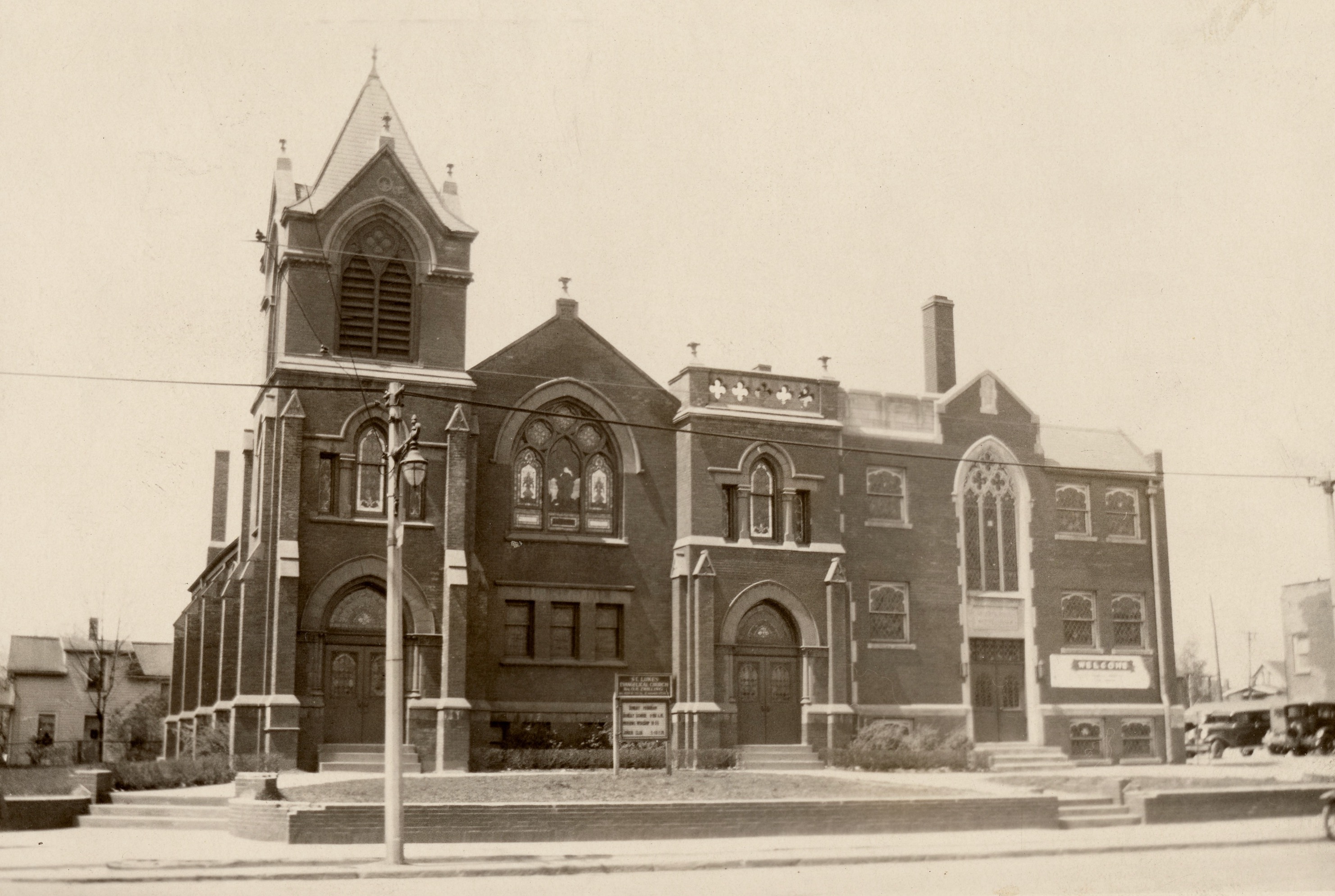
PHOTO COURTESY OF THE CLEVELAND PUBLIC LIBRARY PHOTOGRAPH COLLECTION
St. Luke’s Evangelical Church, 4216 Pearl Rd., on the northwest corner of Memphis Ave. This streetscape view of St. Luke’s is from the 1920s, after the addition on the north side of the church was completed and dedicated in late August of 1925.
by Lynette Filips
(Plain Press July 2025) “A picture is worth a thousand words”, and this month I’m thrilled to be able to present three different old photos of previous church buildings used by the congregation formerly located on Pearl Rd. at the corner of Memphis Ave. These new discoveries happened as an unexpected result of reading the “History of Evolution & Transformation: The Abandoned Burial Ground at Memphis and Pearl” article in the Summer edition of the Old Brooklyn News (OBN). Statements in that article prompted me to closely examine the St. Luke’s file folders at the Historical Society of Old Brooklyn (HSOB) Museum as well as the records in the History Department at the main Cleveland Public Library (CPL).
Not only did I find the factual/correct information I was seeking (and other interesting stories), but I also discovered the three old photographs accompanying this article: The little frame German United Evangelical Church of Brighton, Ohio; The brick St. Luke’s Evangelical Church in its younger days when it had a steeple on its left tower and a parapet wall on its right tower; and St. Luke’s brick “School of Religion” (plus rooms for other activities) at the time it was newly built onto the north side of the church.
What’s especially wonderful to a local historian like me is that the c. 1857-1860 house — which is currently slated for demolition — is visible in the back of all three of the photos. As related in last month’s article, by our best calculation it’s 165-168 years old and is one of the oldest buildings in Old Brooklyn.
Especially touching stories that I recently read in the articles in old newspapers and church dedication books include those relating to the dedication ceremonies of two of the structures. There was nothing describing the 1853 dedication of the former frame church, but there was a beautiful description of the 1904 dedication of the new brick church. It told how the congregation held a farewell ceremony in their old frame church and then processed over to the dedication ceremony for their new brick church. What a find it would be if someone whose family belonged to the congregation at that time has old photographs that they could share with the HSOB!
Twenty years later the congregation had grown so much that they needed to, and were able to, have an architect design and build an addition onto their original church. It contained a recreation hall (kitchen, dining room, serving rooms and dressing rooms) in the basement level; an auditorium/overflow worship space/parlor and offices on the main floor; and Sunday School classrooms and the pastor’s study on the upper floor.
The headline for the article covering this event in the Friday, August 21, 1925, edition of the Brooklyn News-Times is “St. Luke’s Evangelical Congregation to Celebrate Dedication and Opening of its New School of Religion Week of August 23 to 30.”
That’s a seven-day celebration for a building which is currently regarded as just expendable classrooms and is slated for demolition before the end of this year. Recognizing the fate being planned for it, for me the most poignant sentence in the article was, “The new building forms a unit with the present church.”
The reason for my research, though, was mainly related to (1) the old burying ground which was originally on this corner; and (2) the location of the original frame church. Some readers of the Plain Press are likely to have read the article in the OBN and assumed that its historical statements were true. But many, unfortunately, are not. Although the author of the article was not listed in the publication, there is an almost identical article online which was posted by Tipping Point Real Estate Development. Tipping Point is one of the companies working on the Old Brooklyn Community Development Corporation’s Memphis Pearl Project.
The OBN article pictures snippets of four old maps, plus two other references to historical records, but the writer’s conclusions are not accurate. “They” say that the entire current grassy area between St. Luke’s and the Greenline Building on Memphis Ave. has previously been built upon, thus disturbing any graves which other people believe remain there.
In reality, the small frame church, which was once there was 50-60 feet from the c.1860 house behind it; the church also had undeveloped land on its other sides.
“They” say that there were two frame German churches, one larger and one smaller, in slightly different locations on the property. They based their conclusion on how they read the black rectangle building symbols drawn on the old maps they consulted.
In reality, the German Evangelical congregation used the same small frame church from 1853 until 1904.
“They” say that the frame church was demolished when the brick church was built.
In reality, the frame church was moved to the corner of Devonshire Rd. and W. 30th St. and was converted into a house.
“They”mention the small house in their commentary about the 1951 map.
In reality, the house had been there since sometime between 1857-1860.
“They” say that this site has been designated as a “historic landmark” and that the City of Cleveland’s Superintendent of Cemeteries and Landmarks Commission will have final approval of the project team’s excavation and demolition plan prior to work beginning.
In reality, St. Luke’s was never designated a Cleveland landmark, and being part of the (Federal) National Register of Historic Places’ “South Brooklyn Commercial District” doesn’t protect it from the City of Cleveland Planning Commission’s decisions. The manager of Cleveland’s cemeteries is aware of the situation, however, and perhaps he will have a say about the site’s future.
Moving on to current updates, in last month’s article I noted that tenants in the Greenline Building(s) had learned that their “order to vacate in 90 days” letters were on the way, and by now those letters have arrived. The final date for them to vacate is August 19, 2025. I have only spoken with Constance (Connie) Ewazen, president of the Historical Society of Old Brooklyn, and so far, she has not found a place to relocate the Museum and to the best of her knowledge, neither have any of the other remaining tenants. They have been visited by the moving company which will execute the move, and by the man from the company facilitating the process, along with OBCDC Interim Executive Director Amber Jones. They told Connie Ewazen that eviction proceedings will be initiated if the HSOB is not out by August 19th.
Because HUD is involved in the (still-incomplete) financing of this project, there are rules OBCDC must follow in the Uniform Relocation Act. It provides some assistance to displaced tenants.
In last month’s article I also mentioned that OBCDC was almost $15 million dollars short in the funding needed for this project. An article in NEOTrans stated that they hoped to come up with the deficit with TIF money and real estate tax abatement. The TIF (Tax Increment Financing) money involves both the City of Cleveland and Cuyahoga County. In the hope of securing these funds, Ward 13 Councilman Kris Harsh proposed emergency legislation related to it at the last Cleveland City Council meeting on Monday, June 2nd, and his colleagues approved it. Time will tell how much the County decides to award to them.
There is much more to be written about HUD’s guidelines for this project, what TIF money is, and my temporarily-on-hold descriptions of the remaining buildings in the “South Brooklyn Commercial District” on the National Register. In the meantime, remember that past articles in my attempt to “Save Our Historic District” are available on the Historical Society of Old Brooklyn’s website, www.oldbrooklynhistory.org, and on the Plain Press’ website, https://plainpress.blog.
Acknowledgments: I am extremely grateful to architectural historian Craig Bobby and to local cemetery author William Krejci for their help in deciphering the old maps; and to Adam, library assistant in CPL’s Photograph Collection; and to architectural historian Craig Bobby for the research/old newspaper articles about St. Luke’s which he added to the HSOB archives years ago when the Memphis Pearl project started.
 Plain Press
Leave a comment