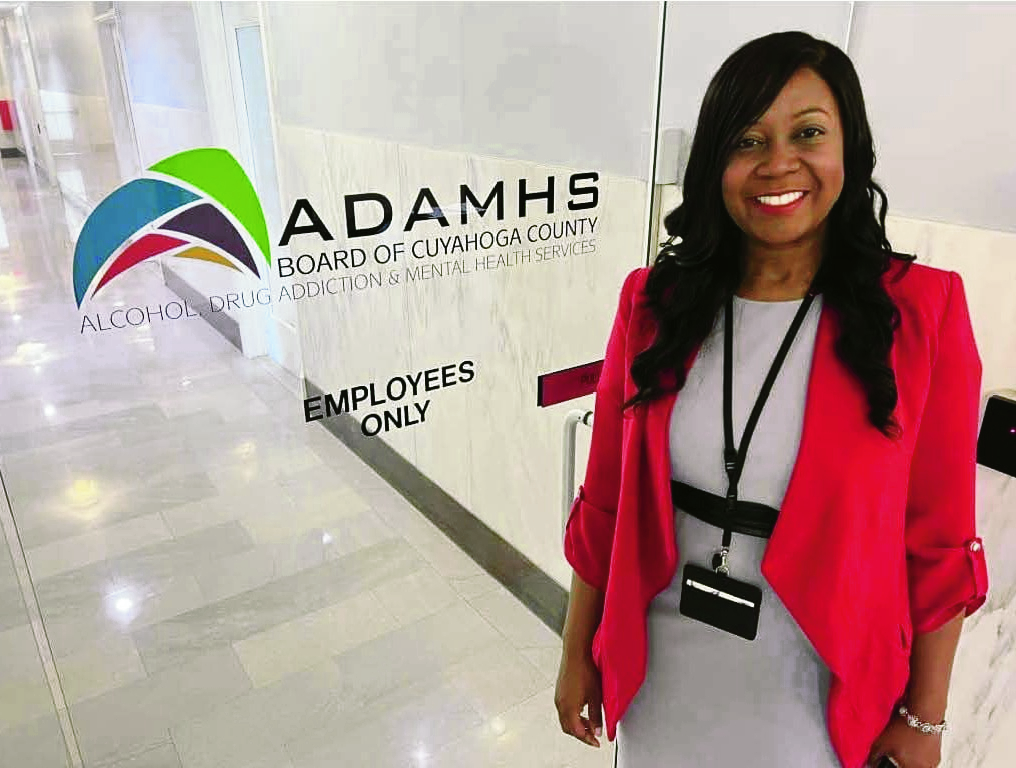
PHOTO BY BOB SANDRICK, THE LAND
Latoya Hunter Hayes, the Alcohol Drug Addiction and Mental Health Services (ADAMHS) board’s chief of external affairs, is working on a new campaign to bring awareness to the 988-hotline resource.
by Bob Sandrick, The Land
(Plain Press July 2025) A county agency charged with helping those with mental illnesses and addictions has launched a public awareness campaign that it hopes will save lives.
The Alcohol, Drug Addiction and Mental Health Services (ADAMHS) Board of Cuyahoga County is promoting the 988 Suicide & Crisis Lifeline on 10 electronic billboards throughout the county. The billboard initiative started in mid-May, which was Mental Health Awareness Month, and will continue through the end of June.
“We want to educate people about 988,” said Latoya Hunter Hayes, the ADAMHS board’s chief of external affairs. “It’s been in place for going on three years, and while recognition of 988 is growing, there are still a lot of people who need to know it’s a resource that’s available.”
In 2022, the 988 hotline replaced the National Suicide Prevention Line, which was accessible by dialing a 10-digit number. The idea of 988 was to make the line easier to remember and dial.
People experiencing a mental health or substance abuse crisis, or even those simply in emotional distress, can call the hotline, which is available 24/7. They immediately speak with a trained mental health counselor who listens, provides support and encouragement and refers them to other resources, if necessary, that can assist them over the long term.
“The 988 system doesn’t always stop at a call,” Hunter Hayes said. “It starts with a conversation, but the counselors can connect people to a mobile crisis team, a behavioral health service funded by the ADAMHS board or a walk-in center.”
Nationally, the 988 network consists of more than 200 call centers throughout the United States. In Cuyahoga County, the hotline is operated by the nonprofit FrontLine Service, an ADAMHS board partner that works to end homelessness, prevent suicide, resolve behavioral health crises and overcome trauma in children and adults.
Statewide, the hotline takes more than 18,000 calls and texts every month. That’s a lot, but the ADAMHS board believes that even more people can be reached. Toward that goal, the billboards aim to destigmatize mental illness.
“We want people to realize that they’re not alone if they have mental health issues and they’re not alone in calling 988,” Hunter Hayes said.
That’s basically the message on the 10 billboards, two of which are near Cleveland Metroparks Zoo off Pearl Road. There are two billboards in Garfield Heights near Interstates 77 and 480; two near the Harvard Road exit of Interstate 271; two near East 4th Street in downtown Cleveland; one in Brook Park near 480 and West 150th Street; and one in Parma near 480 and Ohio 176.
“That was where billboard space was available,” Hunter Hayes said. “We tried to spread them throughout the county as much as we could.”
A $10,000 grant from the Ohio Department of Mental Health and Addiction Services, awarded through the Ohio Association of County Behavioral Health Authorities, is paying for the billboard space. An estimated 2.5 million pairs of eyeballs will see the messages.
Pandemic effect
Services like the 988 hotline are needed now more than ever.
The COVID-19 pandemic intensified mental health and substance abuse disorders nationally, with people experiencing heightened levels of anxiety, depression, and addictions, according to a 2024 Community Needs Assessment by the ADAMHS board and RAMA Consulting in Columbus.
The study said that annual drug overdose deaths increased by 30 percent during the pandemic and there was a threefold increase in people reporting anxiety and depression.
Medical providers who participated in the study reported an increase in post-COVID trauma, especially among children, and a rise in opioid addiction and overdoses.
“The pandemic precipitated a surge in substance use and mental health challenges, fueled by heightened stress, social isolation, and disruptions to daily routines,” the ADAMHS study said. “Traditional support systems, like in-person meetings and established networks, were compromised, intensifying feelings of isolation and leading to relapses and deteriorating mental health.
“Moreover, the socio-economic fallout, marked by job loss, financial strain and inflation, exacerbated these issues, worsening vulnerabilities and impeding access to essential support services,” the study said.
The Pew Research Center found in 2023 that 58 percent of Americans ages 18-29 have dealt with high levels of psychological stress since the COVID-19 outbreak, based on surveys with that age group.
In Cleveland, nearly 25 percent of adults surveyed reported having 14 or more days of poor mental health within a 30-day period, an increase from 20 percent in 2015 and about 12 ½ percent in 2005.
The survey, done by the city of Cleveland, the Case Western Reserve University School of Medicine and Healthy Neighborhoods, also found that nearly 42 percent of participants were diagnosed with depressive disorder in 2025, an increase from 26 percent in 2015.
Today, about 21 percent of adults in the United States suffer from a mental illness, according to the ADAMHS study. That number equates to about 50 million people. About 5 ½ percent have severe mental illness and nearly 5 percent, or more than 12 million people, think seriously about suicide.
The problem is that 54 percent of those with mental illness don’t receive treatment.
Meanwhile, 15 percent of adults reported having a substance abuse problem and 11 percent abused alcohol. But 94 percent of them didn’t get help, according to the ADAMHS study.
Stigma is one of the biggest obstacles blocking people from seeking help, which only makes matters worse for them.
“Addressing stigma through awareness campaigns and community education is essential to foster a supportive environment where individuals feel comfortable accessing mental health services,” the ADAMHS study said.
According to the Ohio Department of Mental Health & Addiction Services, several studies have demonstrated that those calling 988 are significantly more likely to feel less suicidal, less depressed and less overwhelmed and are more likely to feel hopeful.
Reaching out
The ADAMHS board isn’t sitting still with the billboard initiative. It’s also working on a pilot project called the 988 care response program. Residents living in the 44102 and 44105 zip codes, upon calling 988, are visited by a social worker and certified peer – a lay person who has been successfully treated for a mental health condition – as long as violence and weapons are not involved in the situation.
“While the 988 hotline already saves lives remotely, in-person care teams can extend that impact by offering immediate, compassionate and practical help,” Hunter Hayes said. “It adds another layer of care for those who need it.”
ADAMHS’ 988 care response pilot project, which started in September 2025 and runs through September of this year, is in partnership with the Cleveland Department of Public Health and FrontLine Service. If the pilot is successful, the program might be expanded into other areas.
Hunter Hayes said the ADAMHS board was encouraged recently when the Ohio Senate included a slight increase in 988 funding in its version of the state budget. The problem is that the Ohio General Assembly has not yet made 988 appropriations a permanent budget line item.
The Ohio Association of County Behavioral Health Authorities and the ADAMHS board hope to change that someday soon.
Editor’s Note: This article first appeared in The Land, an online publication. The Land is a local news startup that reports on Cleveland’s neighborhoods. Through in-depth solutions journalism, The Land hopes to help to foster accountability, inform the community, and inspire people to act. To read more articles from The Land, visit www.thelandcle.org. The Land is also available on social media @LandofCLE (Twitter) and @TheLandofCLE (Instagram and Facebook).
 Plain Press
Leave a comment