
PHOTOS COURTESY OF RONALDO RODRIGUEZ, JR., LA VILLA
On July 14th, Ward 7 City Council candidates participated in a Neighborhood & Community Media Association of Greater Cleveland Community Media Panel discussion with reporters from Tremonster, Plain Press, and La Villa.
by Bruce Checefsky
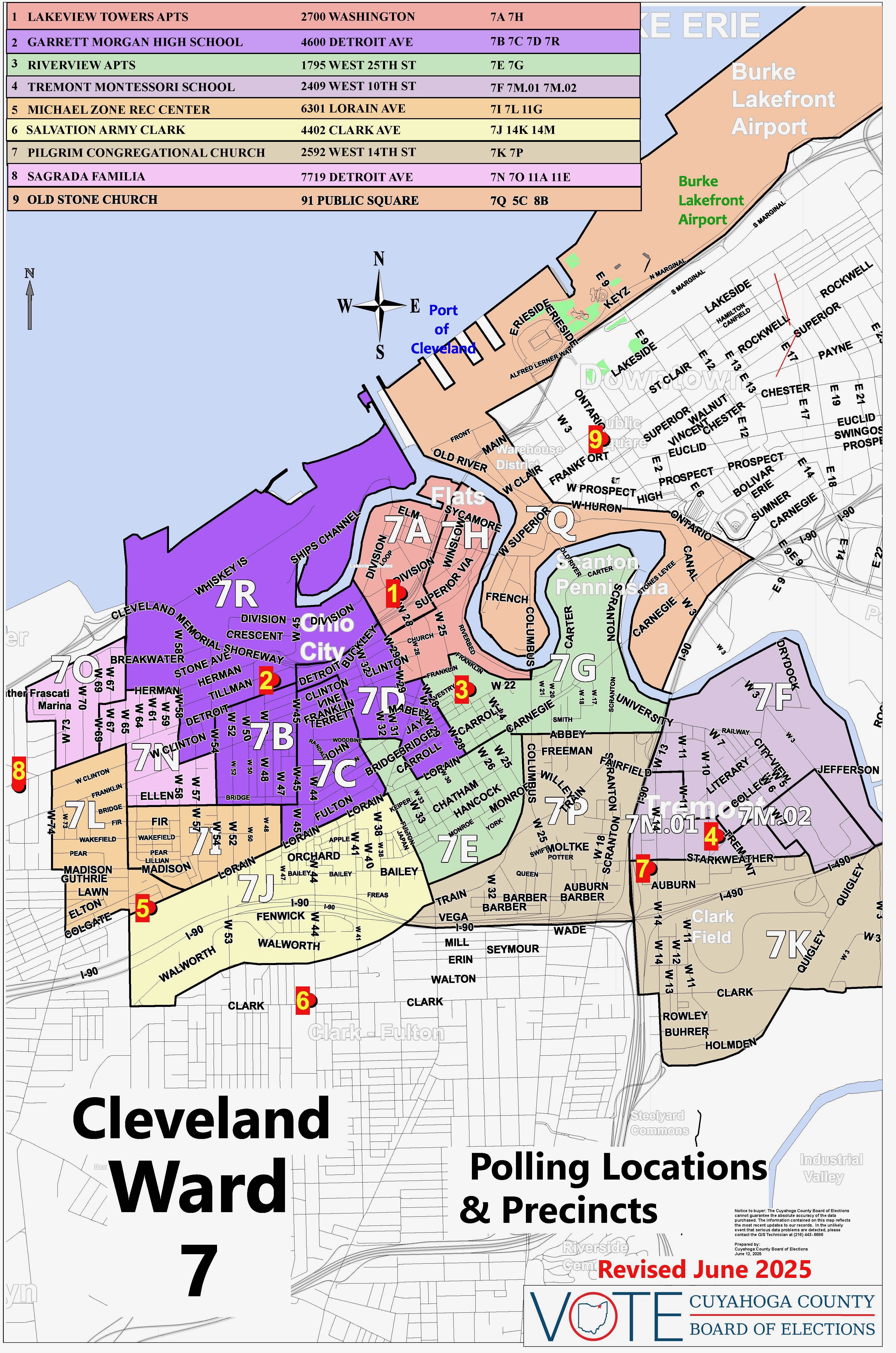
(Plain Press August 2025) Cleveland City Council Ward 7 candidates Austin Davis, Mohammad Faraj, and Mike Rogalski gathered at the City Church in Tremont on July 14th for a panel discussion with local media to pitch their campaigns. Cleveland City Council Member Kerry McCormack, elected in 2016, is not seeking re-election. Ward 7 is being reconfigured from the former Ward 3, as the City of Cleveland reduced the number of wards from 17 to 15 earlier this year because of population decline.
Davis, former senior policy advisor to Mayor Bibb and a resident of Tremont, is running on a platform that includes housing, safety, transportation, and community parks. Davis was born into a family of local union crane operators that helped build the bridges and buildings in the city. His father worked 14-hour days in the salt mines. He holds a Doctor of Law degree from Harvard Law School and a Bachelor of Arts in Political Science from Middlebury College.
“I am a person with a disability, an amputee, who lost both of my legs when I was twenty,” said Davis. “It was in a train accident. A traumatic event, but I walk today. I credit my family for the no-holds-barred commitment to pushing myself forward. It got me to where I am today.”
Davis fostered legislation for zoning reform and Cleveland’s Residents First code enforcement overhaul to protect renters from slum landlords and fight urban blight while working for the Bibb administration. He spent a year on gender equity and transparency legislation, which the Cleveland City Council passed in April, an ordinance aimed at reducing the gender and racial wage gap.
Under the new law, employers are prohibited from asking job applicants about current or previous salaries during the hiring process. All formal job postings must include salary ranges or pay scales, helping ensure greater transparency and fairness for job seekers. He also pushed forward smoke shop and tobacco regulations, the first of their kind in Cleveland.
“It all comes down to getting home at the end of the day and my power is out in Tremont, or I wake up the next morning and my driver’s side mirror is knocked off into the middle of the street by an unsafe driver because traffic is out of control,” said Davis. “Or a house on the street from where I live burned down, and nothing is being done to clean it up. I live here. This is my community. These are issues that are on my mind.”
Cleveland has one of the fastest-growing rent increases in the country with a housing crisis, he said. Recently published reports showed Greater Cleveland ranked third nationally for the highest percentage rent increase, 5.6% over the last 12 months, more than double the 2.6% growth in the state of Ohio.
Without intervention from the federal government, landlords cannot build and operate apartments that are affordable to people with the lowest incomes on their own because the rent that those lowest-income people can afford to pay does not cover the costs, according to Diane Yentel, CEO of the National Low Income Housing Coalition, in a recent PBS interview with John Yang.
Faraj, a first-generation Palestinian American, grew up in North Olmsted and graduated from Westlake High School. He holds a Doctor of Law degree from Valparaiso University and attended Cleveland State University, where he studied biology and sociology. He lives in the Detroit-Shoreway neighborhood and currently works in Enterprise Risk Management for Bitcoin Depot; a cryptocurrency publicly traded on NASDAQ.
Faraj is co-founder and vice president of internal affairs of Arab Americans of Cleveland–Young Professionals Network and a founding member of the Arab American Bar Association of Ohio (AABAR-OHIO). He was named to Crain’s Cleveland 40 Under 40 last November.
His campaign agenda includes improving City services and public safety, revisiting policing policies, and expanding the tree canopy. Providing affordable housing to the community tops his list of concerns for the community.
“This is a critical issue,” said Faraj, referring to the spike in housing costs, including rentals, in the city and a shortage of affordable homes. “I am listening intently and hearing in my conversation with constituents how important this issue is among residents. I am invested in what the response should be from the City Council.”
He suggested supporting flexible development with low-income housing while prioritizing issues related to renter protection without favoring property owners and landlords.
“These issues need to be appropriately prioritized,” he said. “I am committed to affordable housing,” adding, “Cuts in federal funding by the Trump administration will negatively impact City services.”
Public safety is key to quality of life and experiencing city services has a broad impact on residents, with true indicators not limited to policing, according to Faraj. People feel safe when the streets are clean when walking in the neighborhood and riding their bikes. Benchmarks include the number of speed tables, for example.
“Detroit has significantly more speed tables than Cleveland,” he said. “I do not understand. This is an easy issue.”
There is interest among state and local leaders to address public safety and the economy, yet these issues are often treated separately, with many recent policy efforts focused on fixing crime in cities, according to the Brookings Institution. Crime comes down to depressed economics, the report said, with efforts to improve the criminal justice system while ignoring the compounding trauma from poverty.
“I am committed to public safety but also amplifying community organizing and block clubs that drive progress,” said Faraj. “It is important to understand this dynamic, so residents do not feel left behind.”
Rogalski earned a bachelor’s degree in urban studies and a master’s degree in public administration from Cleveland State University. He was born in Bedford and got his start in local politics with the Bedford/Walton Hills Democratic Party and the Bedford Heights Democratic Club. He worked with the late Judge Raymond Pianka at the Cleveland Housing Court and for several Cuyahoga County Health & Human Services agencies, including the Child Support Enforcement Agency and geriatric and disabled populations at the Division of Senior and Adult Services. He currently lives in Tremont.
A self-proclaimed progressive, Rogalski ran against McCormack in 2021, finishing a distant third behind the sitting council member and challenger Ayat Amin. His platform back then was much the same as now: addressing property tax increases, luxury tax abatement, and public safety.
Labeled by some local media as combative, Rogalski responded, “I know who I am. I know what it is like to have my needs ignored,” referring to his background growing up in a challenging family environment. “I know what it is like to talk to people who are well-meaning but have their hands slapped away when they ask for help.”
While searching for an apartment in Tremont recently, he found affordable housing not affordable, with one- or two-bedroom apartments starting at more than $1,500 a month. It was out of his price range. He eventually found something less expensive.
“I do not support tax abatements for luxury apartments, at least not in our ward or neighborhood. The program has served its purpose,” said Rogalski. “Tremont is unaffordable to many.”
Tax abatement drive developers to purchase older homes and demolish them, displacing residents. Communities suffer the consequences; wealth and resources get extracted, according to him.
“The councilperson for this ward, whoever that is, will have to make difficult decisions against the grain of the city and constantly face headwinds,” he added. “The residents of Ward 7 demand different things from other wards. The political structure does not always support an independent voice.”
The primary election is September 9, 2025. Check your voter registration and polling location on the Cuyahoga County Board of Elections website or call 216-443-VOTE (8683).
 Plain Press
Leave a comment