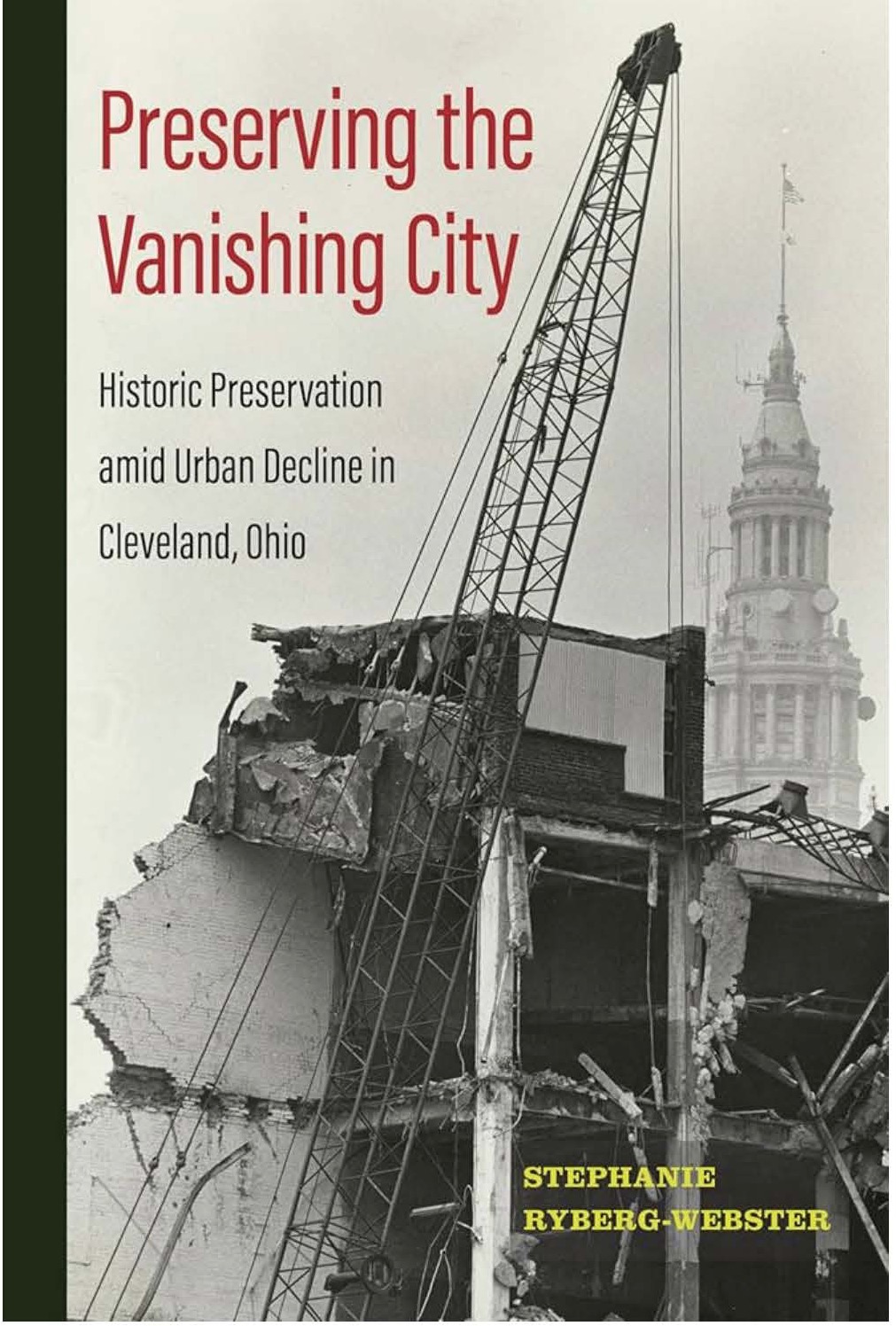
IMAGE COURTESY OF STEPHANIE RYBERG-WEBSTER
Stephanie Ryberg-Webster, associate professor in the Department of Urban Studies at Cleveland State University’s Levin School of Urban Affairs, is the author of Preserving the Vanishing City: Historic Preservation Amid Urban Decline In Cleveland, Ohio. She was one of three persons speaking about the topic of Preservation Advocacy at a 2025 Cleveland History Days event at Metropolitan Coffee, 4744 Broadview Rd. in Old Brooklyn, on June 23rd. Perhaps her most powerful statement of the evening was that there’s no old building which can’t be saved.

PHOTO BY CHUCK HOVEN
For the second time, the Ohio Department of Development has awarded Ohio Historic Preservation Tax Credits for these two buildings (left to right) 4209 and 4221 Pearl Road. The duo, which were most recently used by Citizens Bank and are included in the South Brooklyn Commercial District on the National Register of Historic Places, are located on Pearl Road across from where Memphis Avenue begins. The building at 4221 Pearl Road, was designed by the architectural firm Dalton and Dalton for The Broadview Savings & Loan Company which moved into the new building in 1948. An additional floor was added in the mid 1950s. The building north of it, at 4209 Pearl Road, built in 1930, was purchased by Broadview Savings and Loan in 1949 to fill a need for additional space. A basement tunnel was built to connect the two buildings. The Ohio Department of Development says the developer who purchased the two buildings will, without altering their exteriors, convert them into 30 apartment units.


IMAGES COURTESY OF THE CLEVELAND PUBLIC LIBRARY
This little gem of a newspaper clipping comes from the November 22nd, 1903, edition of The Plain Dealer, accessible at the Cleveland Public Library’s Plain Dealer Historical database. It clearly establishes that in 1903 a cemetery was still associated with the Evangelical Church (most recently known as St. Luke’s United Church of Christ) at the corner of Pearl Road and Memphis Avenue. The last sentence supports everyone who believes that the cemetery is important and wants it to be spared from the planned new construction. To the left is an image from the Cleveland Leader with additional information about mortgaging the cemetery.
by Lynette Filips
(Plain Press August 2025) “Where thousands save millions” was an advertising slogan of an Old Brooklyn-founded banking institution. In 1956, it was the largest savings and loan association in Ohio. That institution is the former Broadview Savings and Loan Company, and this month we are pleased to announce that not only are Broadview’s two former buildings in Old Brooklyn going to be preserved on the exterior and adaptively reused on the interior, but that the undertaking will be accomplished with the help of Ohio Historic Preservation Tax Credits (OHPTC).
On June 25, 2025, in the 34th round of awards, each of the buildings received grant money, and that’s the second time it’s happened; the buildings also receive OHTPC money in the 33rd round last December. Here are the details about the history of the buildings, the banking institutions, and the value of the awards.
(If you’ve read about the awards in other publications, this information will be somewhat different because there are errors in previous accounts, even in the account from the Ohio Department of Development which issued the press releases.)
The former Broadview Savings and Loan Company building at 4221 Pearl Rd., one of the recipients of OHPTC funds, was constructed in 1948 (not in 1919 as stated elsewhere). The banking institution, however, was founded in 1919 and its first office was located on the northwest corner of Pearl Rd. and Broadview Rd. Four years later, the magnificent Pearl Street bank building was constructed on the northeast corner of Pearl Rd. and Broadview Rd. and in 1924, Broadview Savings moved into a separate bank space in the back, accessed via 3344 Broadview Rd. (Decades later, the Old Brooklyn Community Development Corporation occupied that space for several years.)
Then in 1948, Broadview Savings moved to the Colonial Revival style building at 4221 Pearl Rd. which was totally theirs. Life was good and in 1955 they added a second story to the building. And for even more space, in 1949 Broadview Savings purchased the Colonial Revival building just north of it at 4209 Pearl Rd. According to a December 2024 OHPTC news release from the Ohio Department of Development, that dual-storefront structure was built in 1930 and occupied by the South Brooklyn Savings & Loan Company and a dry goods store. (That Depression-era banking institution is not familiar to us, and we would be happy to hear from anyone who remembers it.) Broadview Savings built a tunnel to connect the two buildings. In 1980 Broadview Savings built a beautiful new headquarters at 6000 Rockside Woods Blvd. N in Independence (near Rockside Rd. and I-77). (The Kent State University College of Podiatric Medicine is in the building now.)
But things didn’t go well for Broadview Savings after that. Interested folks can read a more detailed account in the “Encyclopedia of Cleveland History”, but here’s what needs to be said for the purposes of this article: in 1987, it became Broadview Savings Bank; in 1989, it became Broadview Federal Savings Bank; in 1990, it became First Federal Savings Bank; and in 1988, Charter One Financial Group was formed to acquire First Federal.
In 2004, Citizens Financial Group acquired Charter One. In 2022, Citizens decided to build a smaller branch office at 4106 Pearl Rd.
That left the former bank buildings at 4221 and 4209 Pearl Rd. vacant and open for redevelopment.
A downtown law firm named KJK submitted requests for OHPTC on behalf of a Beachwood developer named TurnDev. TurnDev plans to construct a 30-unit apartment complex within the two buildings, with 22 units in the Broadview Savings building (4221) and 8 units in the South Brooklyn Savings building (4209). They anticipate that the conversion of 4221 Pearl Rd. will cost $5 million dollars and the conversion of 4209 Pearl Rd. will cost $1.37 million dollars.
The Broadview Savings building most recently received $916,000. in OHPTCs (in addition to the $373,000. it received in the 33rd round last December) and the South Brooklyn Savings received $250,000. in OHTPCs (in addition to the $180,000. it received in the 33rd round.)
And here’s more upbeat news — On Saturday, August 26th, Old Brooklyn’s Historic District, located around the intersections of Pearl Rd., Broadview Rd. and Memphis Ave., was the subject of one of the “Snoops” tours which the Cleveland Restoration Society (CRS) sponsors for its members. Five CRS staff members were in attendance, but they did not conduct the program. Fifty CRS members, from neighborhoods as near as Old Brooklyn and municipalities as far as Chesterland registered for the event.
The tour began at 9 a.m. at Ariel Pearl Center, 4169 Pearl Rd., owner-developer Radhika Reddy, one of three partners on the Ariel Ventures team and a Cleveland Restoration Society trustee, explained how she refashioned a vacant US Bank building into the elegant reception space it is today. Constructed in 1923 for the Pearl Street Savings & Trust Company, Antonio DiNardo of the Cleveland firm of Hubbell and Benes was the architect. The following year the Cleveland Chamber of Commerce recognized the structure as the Best Small Commercial Building of 1924. (Ariel Pearl Center is one of Radhika’s four building transformations in Northeast Ohio. The other three are: Ariel International Center, on E. 40th St. just east of downtown Cleveland; Ariel Broadway Hotel in Lorain; and Ariel LaSalle Theatre on E. 185th St. in Cleveland.)
Next the CRS group walked down to Pearl Road United Methodist Church’s (PRUMC’s) Fellowship Hall to hear about the Old Brooklyn Community Development Corporation’s (OBCDC’s) Memphis Pearl project. After an introduction by OBCDC Neighborhood Development Director Charles Kennick, PRUMC Trustee Tom Hite and Cleveland Ward 13 Councilman Kris Harsh explained the history of the church and their proposed project at the corner of Memphis Ave. and Pearl Rd.
If it receives funding, it will preserve the church proper portion of the former St. Luke’s United Church of Christ as well as a good part of the still-operating Pearl Road United Methodist Church. It will demolish the 1925 addition on the north side of St. Luke’s, the pre-1860 house behind it, part of PRUMC and two buildings on Memphis Ave. which are southwest of St. Luke’s — the 2-story Greenline Building and the 1-story commercial building next to it.
The development project intends to replace the demolished buildings with a 6-story apartment building which will have retail space on the ground level and a brewery or a restaurant inside St. Luke’s sanctuary.
At the end of the formal part of the tour, the CRS invited its members to sample a slice of cheesecake at Slices Fabulous Cakes, 4190 Pearl Rd. (located in a building which is also part of the historic “South Brooklyn Commercial District”.)
Some participants walked down Pearl Rd. to see the outside of St. Luke’s, but there was no formal presentation there.
We are also pleased to be able to share a second illustration this month, the cover of a book written by one of the 2025 Cleveland History Days speakers at Metropolitan Coffee —Stephanie Ryberg-Webster. Among the topics detailed in her book is the painful story of the demolition of Old Brooklyn’s former Broadvue Theatre. A shortage of money was the issue and admittedly the theater was a money pit. A “dollar store” isn’t what was promised but it is what the community got when politicians decided that the grand old theater wasn’t going to get any more of their funding. The panel discussion at the coffee shop didn’t discuss the demise of the theater in detail, though, because this year the focus of their advocacy presentation was the preservation of Cleveland’s industrial artifacts.
The sand in the hourglass has almost run out for the four tenants in the building next to the Greenline Building whose last day to vacate their rental spaces is August 19th. Neither Connie Ewazen, president of the Historical Society of Old Brooklyn, or Maria the Barberette or Rocco from A Reliable Construction or the owner of the recording studio have moved out or been able to find appropriate space to rent. (In next month’s article we may be reporting about their experiences of being evicted!)
Since the little congregation still worshipping at PRUMC has not yet been notified to leave their space, it is unclear why the tenants in the building next to the Greenline Building have already been ordered to vacate. OBCDC is still $15 million dollars short of the funding it needs to complete their project.
Till next month, remember that you can access past articles in this series on the Historical Society of Old Brooklyn’s website, www.oldbrooklynhistory.org or on the Plain Press’ website, https://plainpress.blog.
(Acknowledgments: I am grateful to Managing Editor Chuck Hoven and Copy Editor Craig Bobby for their continued assistance in helping me to seek out the information necessary to make these articles as factually correct as possible.)
 Plain Press
Leave a comment