PHOTO BY BRUCE CHECEFSKY
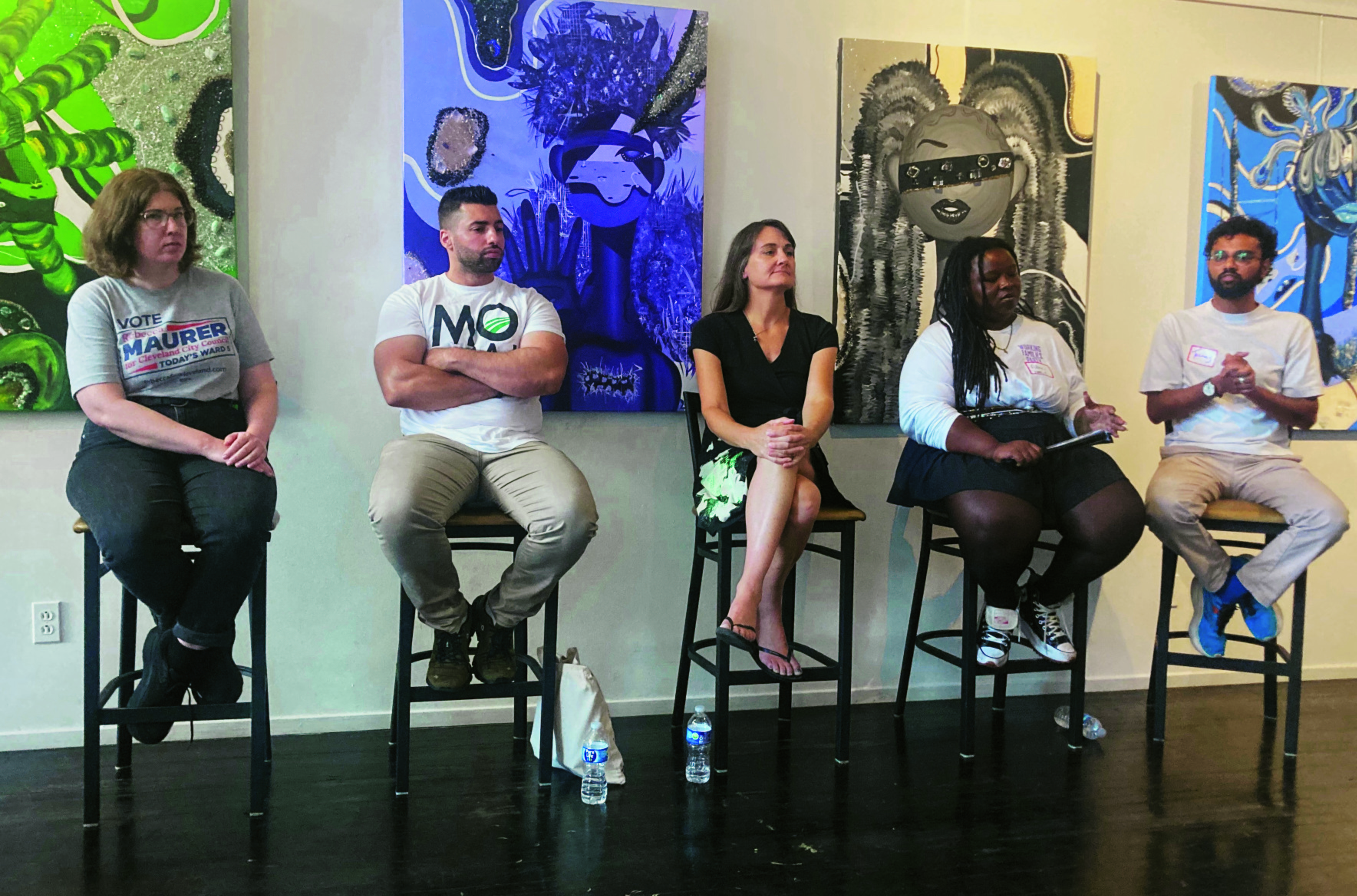
Sunday, August 10, 2025; Working Families Party and Allies Cleveland Policy Forum, Artfully Phi Gallery in downtown Cleveland, 740 W Superior Ave # 101: Cleveland City Council Candidates (L to R) Rebecca Maurer, Ward 5; Mohammad Faraj, Ward 7; Nikki Hudson, Ward 11; Alana Belle, Ward 9; and Tanmay Shah, Ward 12.
by Bruce Checefsky
(Plain Press September 2025) With voters set to decide the outcome of several City Council seats in the Municipal Primary Election on September 9th, the Working Families Party and allies hosted a Cleveland Policy Forum featuring the party’s endorsed candidates: Rebecca Maurer, Ward 5; Mohammad Faraj, Ward 7; Alana Belle, Ward 9; Nikki Hudson, Ward 11; and Tanmay Shah, Ward 12. The forum took place last month at the Artfully Phi Gallery in downtown Cleveland.
Tessa Xuan from the Asian American Midwest Progressives of Ohio (AAMP OH) and Dallas Eckman from the Party for Socialism & Liberation (PSL) and the Cleveland Liberation Center were moderators, along with residents Piet Van Lier and Jenna Thomas.
The agenda included the “Our City, Our Future” local policy platform; candidates elaborated on themes ranging from creating and sustaining an affordable, safe, and healthy city to improving city services and establishing more affordable public transportation.
In an interview with the Plain Press several days before the forum, Aleena Starks, Ohio Director, Working Families Party (WFP), said in the state of Ohio, candidates run through the Democratic Party because WFP does not have a ballot line, while other parts of the country, like New York and Connecticut, have fusion voting.
“In those states, we have candidates that run on the WFP ballot line,” explained Starks. “In Ohio, we actually work with the Democratic Party. We oppose fascism and keep the bad guys out of office by running candidates from the community that truly understand the constituents they try to serve.”
WFP aligns itself with Democratic Party policies when applicable, but not always, she added.
“We like to think of the Democratic Party as a large coalition with WFP as the progressive arm or the left faction. We exist because voters do not see themselves in a two-party system. We provide an alternative vehicle to democracy.”
Endorsement committees throughout the state determine which candidates the WFP supports. The process involves a questionnaire that covers a range of policy issues, and a vote to endorse candidates takes place later. The Ohio Working Families Party (OHWFP), a progressive grassroots political party, has been a multiracial and multigenerational feminist movement for working people since 2017.
The impact of WFP in advancing policies, like raising the minimum wage, establishing paid sick and family leave, investing in public education, and taxes on the wealthy, has been significant.
In 2021, the OHWFP set up local endorsement committees of WFP members, activists, supporters, and voters. WFP endorsed a slate of majority-POC (People of Color), majority-women, and young candidates, including four who hold elected office. Their funding comes from partnering with national interest groups like the Movement Voter Project, as well as individual donations and private foundations. Each state is required to raise their own money for programming. WFP has successfully elected candidates at various levels of government, from city councils to state legislatures, across the country.
A disappointing voter turnout in Cleveland in the most recent municipal election averaged approximately 23%, with a few wards reporting as few as 766 votes (Ward 14). This gives some candidates endorsed by WFP an advantage, according to Starks.
“We see a path to victory because voter turnout is low,” she said. “Especially in wards where incumbents have gotten comfortable in their seats.”
Following an introduction by each of the candidates, Xuan asked Maurer about policies that deliver affordable, fresh food in a city ward known as a food desert, where residents face challenges in accessing grocery stores. The new ward map, passed by council under Council President Blaine Griffin, eliminated Maurer’s Ward 12 and places her address in a ward with incumbent Richard Starr. They will face off in the November election in the redrawn Ward 5, which extends to Slavic Village, where she lives, and part of Old Brooklyn, Central, Downtown, and Kinsman.
Central and Kinsman are the heart of the food desert, said Maurer, where fresh fruit and meat are hard to find. Dave’s Market at Arbor Park Plaza closed in 2019. There has not been a grocery store available to the community since then. She highlighted three potential avenues for relief.
“Central Kinsman Wellness Collective is a farm stock model that was successfully launched in Ann Arbor, Michigan. Essentially a consignment model for farmers, we hope it can turn into an effective model if we get the funding,” she said. “Municipally owned grocery stores with government subsidies are catching on in places like New York City and Chicago. St. Vincent Sisters of Charity is interested in bringing Goodwill to have a nonprofit mall grocery store.”
Xuan asked Belle and Hudson a similar question about food insecurities and access. Each listed a range of citywide distribution centers and diverse policies that could increase the flow of healthy food into the neighborhoods.
Belle added that churches and community centers are good sources for information and food, while Hudson suggested residents should grow their own food.
“One of the first things I became involved with in my block club was saving neighborhood orchard trees from being destroyed. We moved apple, pear, and peach trees near a low-income housing development,” said Hudson, running for the seat in the newly created Ward 11, a district that will include parts of Edgewater, Cudell, Stockyards, Brooklyn Centre and Old Brooklyn neighborhoods. “Residents helped maintain the trees and picked the fruit.”
Eckman cited city services as a concern to residents. He asked Belle about building powerful neighborhood networks that can help cover financial, logistical, and technical support that might not otherwise cover residents’ needs. Born and raised in Glenville, Belle has been an organizer and activist for over a decade.
“We need to highlight and incentivize folks who have more needs with those who have less,” said Belle. “We can highlight the need and purpose of the resource distribution, which can look like home maintenance, for example. Many of our senior population need help in taking care of their homes.”
Networks of people with tools and skills can assist residents with repairs. “We can grab some gloves and clean up a park,” she added.
Faraj, a first-generation Arab American, who is Palestinian, is up against Austin Davis and Mike Rogalski after incumbent Kerry McCormack declined to run again. The newly drawn Ward 7 includes parts of Tremont, Ohio City, Downtown, and Detroit-Shoreway.
Faraj supports improved public transportation and solving the food desert crisis throughout the city. Senior citizens with mobility issues, unable to access food or health services, are a major concern. The Councilperson should be readily available and actively serving the interests of the residents, according to him.
“The Councilperson is the closest elected leader to local government,” he said. “Feeling emotionally connected is important. Hosting regular meetings like town halls, designed to hear the voices of residents. With a disparity of access to leadership in local government, people feel disengaged from the process.”
Tanmay Shah, an Indian immigrant, is a union organizer, lawyer, and truck driver who wants affordable housing, affordable groceries, and reliable city services. He is a candidate for Ward 12, running against incumbent Danny Kelly.
“City services are an important piece of your platform,” said Beckman, addressing Shah. “What city services aren’t working, and what would your approach to addressing them be? How would you decide which of these issues to prioritize?”
“If you have ever been to a public park in the summer in Cleveland, you understand the struggle,” said Shah. “There are limited hours and staff. This is disappointing on so many levels. Children deserve to have access to a pool when it is hot, just like children in Lakewood and Avon. Cleveland residents deserve better. Funding for lifeguards is just a matter of putting ward resources towards it.”
Jenna Thomas, a new Ward 13 resident, asked about public transportation, referring to a one-million-dollar grant to the City of Cleveland given by the Ohio Department of Transportation to redesign East 55th Street with separated bike lanes and increased safety for one of the city’s most dangerous streets. She wanted to know how community engagement could increase the success of such programs.
“Residents need to see and feel these changes,” replied Maurer. “And right now, there are a lot of changes on paper.”
 Plain Press
Leave a comment