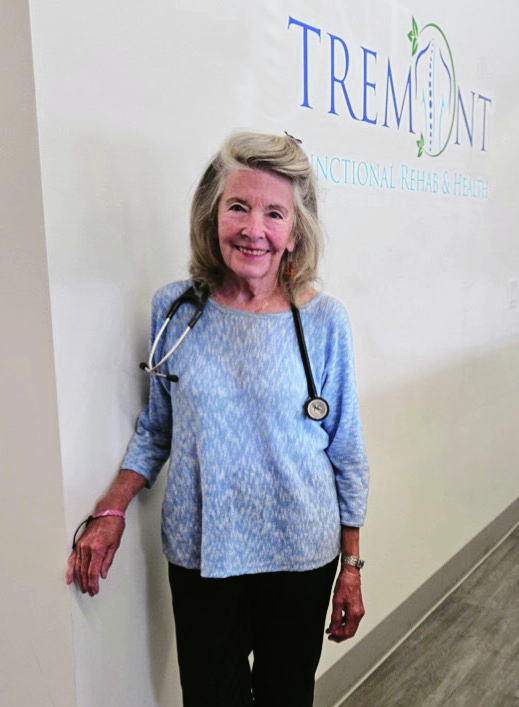
PHOTO BY RICH WEISS
August 2025: Tremont Functional Rehab & Health, 2401 Scranton Road: Dr. Joy Marshall moved her existing general practice in with the practice collaborative at Tremont Functional Rehab this past month.
by Bruce Checefsky
(Plain Press October 2025) Dr. Joy Marshall, from Cleveland Heights, attended medical school at the age of 36. By most standards, starting medical school at that age can be a significant challenge. Living off welfare prior to that for years with her two kids, she earned income by working the local restaurant scene. Married at age eighteen, Dr. Marshall lived in Oaxaca, Mexico for a year. Returning to Cleveland, she and her husband started a restaurant in University Circle called Fantomas (now L’Albatros). Two children later, they ended up divorced and she began working as a barmaid and specials cook at Nighttown on Cedar Road.
One day, the president of Case Western Reserve University, Louis A. Toepfer (presidency years 1970–1980), came to lunch as he often did and struck up a conversation with her. He asked her what she was doing with her life. “I know it sounds ridiculous,” she told Toepfer, “but I want to try to go to medical school and am thinking about doing the undergraduate work at Cleveland State.”
Toepfer told her “We have a nice little university down the hill (CWRU).” She thought about her age. He reminded her that despite her age, life experiences were worth something—learning to speak Spanish, helping to establish a successful restaurant, and raising two children as a single mother were significant achievements.
But Marshall could not afford the tuition. “You get in; there are grants out there,” Toepfer told her. He gave her the name and phone number of the pre-med dean at the university. She got in.
Dr. Marshall now relates this story to her patients.
“Even though I was a middle-class kid, my parents were never encouraging me to go to college, to have a profession. When I started work as a doctor, talking to my patients felt like I was looking in the mirror. But somehow, I had the wherewithal to believe I could make it. A lot of my patients were beaten down before they could even get started.”
Dr. Marshall figured out how to attend college while on welfare as a way to support her family. “Back then, college was considered a job by the government: my family was eligible for welfare. I got rent and food stamps, health care, and day care for my children. Those days are gone.”
When she was a little girl, her father, a doctor at Huron Medical Hospital in Cleveland, would take her on his rounds on Saturdays. The experience scared her, but every time her father walked into a patient’s room, regardless of their medical condition, the patients smiled.
“After that experience, I told my father that I wanted to be a doctor,” she said. “I could see how his presence helped patients for the better. I wanted to do that,” Dr. Marshall explained.
“Funny thing, he would tell me I would just get married and have babies—which, truth be told, I did.” She didn’t go to college until she was 28.
Following a tough upbringing and life, her father discovered the overwhelming healing powers of the doctors and medicine after injuring his back, and that alone convinced him to go to medical school. He too did everything “late.” Dr. Marshall followed in his footsteps, joining the medical profession later in her life.
When asked about the current vaccine debate issue under the Trump administration, she did not hesitate to express her opinion. “Robert F. Kennedy Jr., currently the U.S. Secretary of Health and Human Services, has a long and highly controversial history of promoting false and misleading claims about vaccines,” she said.
“Back when I was a resident doctor, every Wednesday there would be what they called ‘Grand Rounds,’”
Dr. Marshall explained. “Doctors and nurses would meet in the auditorium for a lecture by a specialist. That week, it was an Infectious Disease doctor. He said to his audience, ‘For all of you out there who don’t get your flu vaccine because you never get sick: how about getting it so that when you breathe on someone more susceptible than you are, you don’t give it to them!’
I had never thought of that before,” she recalled. “It’s a public health issue. For me it’s also a moral issue.”
Dr. Marshall also speaks Spanish, which helps patients struggling with English in a very diverse part of the city. The Clark-Fulton neighborhood on Cleveland’s West Side, just a few blocks from her office, has the highest concentration of Hispanic residents in Cleveland and Cuyahoga County.
“Working with surgeon Dr. David Perse (the former head of both Lutheran Hospital and then St. Vincent Medical Center) at Tremont Functional Rehab and Health, has been a remarkable experience,” she explained. Dr. Perse can see her patients the following day, rather than having them wait weeks or months for an appointment at the larger medical centers and hospitals.
“I want to send my patients to a person, not a department, like orthopedics, for example. I want them to know the doctor taking care of them,” she said. “It is getting harder to do, but here, at Tremont Functional Rehab and Health, we have specialists I can recommend who are readily available and personable.”
From the start, Dr. Marshall defines her doctor-patient relationships differently than larger medical centers. “Whenever I see a new patient, I make sure that they understand this is a partnership. I work for them.”
Tremont Functional Rehab and Health accepts health insurance of all types. With medical costs soaring and fewer people able to pay for health care, Dr. Marshall has an opinion about medical coverage in the United States.
“We are the only developing country in the world that does not take care of its own people,” said Dr. Marshall. “I want to see universal medical care in this country, much like in Canada, and avoid wasting money on navigating the complex health care system.”
 Plain Press
Leave a comment