by Lynette Filips
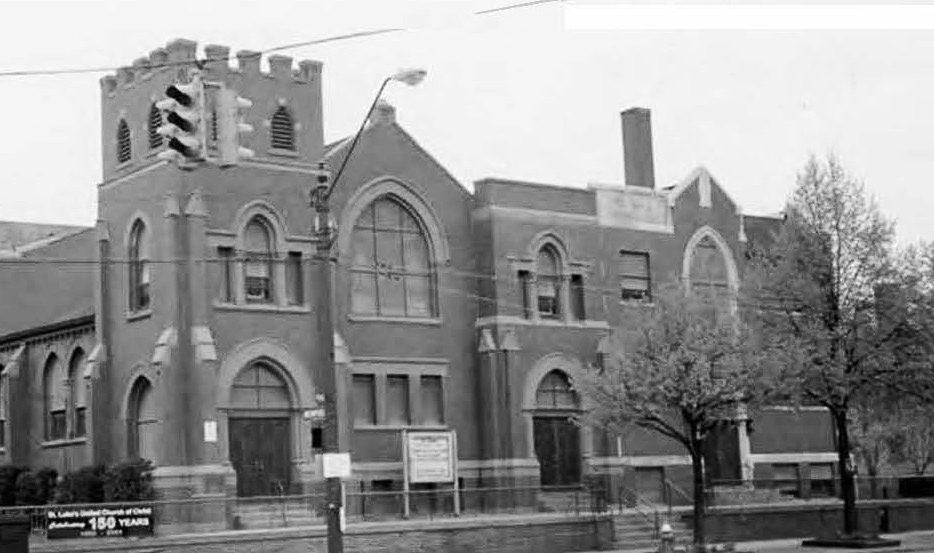
PHOTO COURTESY OF THE HISTORICAL SOCIETY OF OLD BROOKLYN
2005 Photo that accompanied the application of the South Brooklyn Commercial District to be on the National Register of Historic Places: On Friday, December 6th, the Cleveland Planning Commission approved the demolition of four buildings on the corner of Pearl Road and Memphis Avenue to make way for a new development. While the original sanctuary of St. Luke’s will be spared from the wrecking ball, the educational addition to the church that begins on the right side of this photo is slated for razing. Neighborhood historic preservation advocates are still trying to save all the buildings and hope that, despite issuing a permit for the demolition, the City of Cleveland will not allow any demolition to occur before the developers with plans for the corner have secured funding for the proposed project.
(Plain Press January 2025) A year has passed since I began writing about the history of the northwest corner of Pearl Rd. and Memphis Ave. For several years now, the Old Brooklyn Community Development Corporation (OBCDC) has been working on plans to “revitalize” it. This time they are working with Desmone, an architectural firm from Pittsburgh, Pennsylvania. The plans continue to change, but the current developer’s plan has always involved: demolishing the northern half of the former St. Luke’s United Church of Christ complex at 4216 Pearl Rd.; demolishing the two Greenline commercial buildings on Memphis Ave.; and demolishing a small, very old house behind St. Luke’s (which likely has some historical significance.) The southern half of St. Luke’s, where the worship space once was, will remain standing. In the future, it could possibly house a restaurant, a brewery and/or community space.
NEWS ANALYSIS
An ultra-modern apartment complex with retail spaces on the first floor would replace the downed Greenline buildings and extend over the grassy area between St. Luke’s and the Greenline Building. Originally expected to be four floors, the height has since been increased to six floors to accommodate more apartments. Changes to the neighboring Pearl Road United Methodist Church are also part of the plans.
In addition to securing the funding to finance the roughly $31 million project, another factor which has been delaying the start of the new construction is finding enough parking space for all the cars which would be associated with the 80-plus apartments and the new retail space. OBCDC also needed to obtain a permit from the city to demolish the four previously mentioned buildings.
OBCDC’s plans came a bit closer to fruition early last month when a majority of the members of the Near West Design Review Committee (which decides such things for Old Brooklyn and surrounding Cleveland neighborhoods) voted in favor of demolition. That same week OBCDC took that vote and their tentative plans for the site to the City of Cleveland’s Planning Commission, and on Friday, December 6th, the Commission issued a permit to have the specified buildings razed. That could happen even before OBCDC secures sufficient parking and funding for their project.
Ken Prendergast covered the story in NEO Trans, an online news source, on Monday, December 9th. His perspective on the project was obviously based on what he had been told, presumably by OBCDC, Ward 13 Councilman Kris Harsh and the Cleveland City Planning Commission’s notes about the meeting and decision. I first saw it posted in a Facebook group called “CLEVELAND STREETS — Then and Now, News and Nostalgia”, but it has since been posted and reposted numerous times in other groups and by other individuals.
I have tried to read all the comments and keep track of the emojis, based on what people read and assumed to be correct. While some persons liked and even loved OBCDC’s plans for the corner, the combined total of the emojis with sad, tearful faces and shocked faces far exceeded the likes and loves.
Steven Hernandez, a reporter and cameraman for both Spanish and English-speaking viewers, was quick to appear at the Greenline Building. He first interviewed Maria, owner of Maria the Barberette, for the Hispanic station, Telemundo News & Media Productions. Understandingly, Maria is very distressed at the prospect of losing her thriving business and the place where she earns her livelihood.
The next week Steven Hernandez interviewed Constance “Connie” Ewazen, the president of the Historical Society of Old Brooklyn. He also interviewed Ward 13 Councilman Kris Harsh and OBCDC executive director Lucas Reeve. Obviously, the thoughts of Connie Ewazen were quite different from those of Kris Harsh and Lucas Reeve. The 19 News “Everywhere at 5” interview has been repeatedly posted online and those who wish to view it can do so.
The Historical Society’s concern about OBCDC’s intended revitalization of the corner which the Channel 19 editor chose to focus on was the displacement of the Historical Society’s museum. The tenants in the Greenline Buildings were informed that they will soon be receiving letters, after which time they will have three months to find a new place and move. A company has been employed to help them find new spaces. Money has been sent aside to help them with the moves.
But this impending move, while important, is not the Historical Society’s most serious concern about OBCDC’s plans. The Historical Society of Old Brooklyn is devastated at the thought of having more historic buildings in the community’s downtown area destroyed, destroyed in the name of progress. The Society is devastated at the lack of respect for what remains of the early community burying ground (cemetery) in the grassy area between the Greenline Building and the St. Luke’s complex. It is further devastated by the lack of regard for the “South Brooklyn Commercial District” designation on the National Register of Historic Places, the application for which is on the National Archives website. It does not understand how a small group of people who happen to be on OBCDC’s Board (and thus in control) now are qualified to make such an important decision — one which will destroy the character of the corner and much of the legacy of past generations.
More History of the Site
In my articles in the last two issues of the Plain Press Italked about how Old Brooklyn’s National Register designation came about, and I also began to describe each building in the historic district. I will continue with that process in February, but before I move on, I must correct an inaccurate statement that I made in last month’s article. In the paragraphs about the building that the Marshall Drug Company erected at the southwest corner of Pearl Rd. and “Short” Broadview Rd., I had added this sentence — “After Marshall’s closed, local pharmacist Fernau Bader had his drug store there.”
While it is true that a Bader pharmacy was on that site, my timing was off, and I confused Fernau with his father Fred who was also a pharmacist. Here’s the short version of the many decades during which both Fred and Fernau Bader operated pharmacies in and near Old Brooklyn’s historic district
As I’d mentioned last month, the original lodge of a fraternal organization known as the International Order of Odd Fellows (IOOF) was in a frame building located where today’s Metro by T-Mobile is. In 1899 a pharmacist named Jake Schmitt began renting space on the ground floor of this original IOOF building. Because his drug store was not doing well, in 1901 he sold it to Fred Bader, who then rented that space in the IOOF building.
In time Fred married and had children. Fred’s oldest son Fernau began working at the family’s drug store in 1915 when he was just 7 years old. Shortly after World War I ended, Fred Bader sold his pharmacy business to the Marshall Drug Company. (It’s very likely that the sale happened in 1922.) Marshall’s, too, rented space from the IOOF until the IOOF decided to build a new brick lodge behind their original one. Then they sold their original lodge building to Marshall’s.
Marshall’s temporarily moved their drug store to a nearby storefront in the new Broadvue Theatre complex (It was demolished in the early 1990s) north of “Short” Broadview Rd. They tore down the former wooden lodge building on the property and in 1926 built the white terra cotta-faced building which is still there today.
As for Fred and Fernau Bader, in the late 1930s Fred bought a pharmacy business from Charles Grega who was operating in a building on the southwest corner of Pearl Rd. and Brooklyn Ave. (where Gyros Guys is today.) In the late 1940s, Fernau Bader bought the business from his father. Fernau owned it until 1972 when he became the pharmacist at Deaconess Hospital and sold Bader Drug to two other pharmacists.
(The source of all this month’s information about Bader Drug and its sale to Marshall Drug was Fernau Bader himself. In the early 1990s, soon after I started writing about local history for the Old Brooklyn News, Fernau began communicating with me from his retirement home in Venice, Florida. His letters were the inspiration for a long-running series called “Old Time Druggists”. That series made its debut in December 1993, and most of what I discussed in the first three articles came from material Fernau told me.)
Preservation-minded folks in Old Brooklyn are still intent on saving their historic district. The Pearl and Memphis corner could be revitalized with adaptive reuse of all the existing buildings and at far less cost than demolition and building new. A highly experienced Cleveland team who wanted to do that bid on this project, but their plan was not chosen.
Read previous Plain Press articles about the rich history of the Pearl-Memphis area on the home page of the Historical Society of Old Brooklyn’s website, www.oldbrooklynhistory.org, and understand why so many people would prefer reimagining these quality, character-filled old buildings to new big box construction.


Leave a Reply