PHOTO BY CHUCK HOVEN
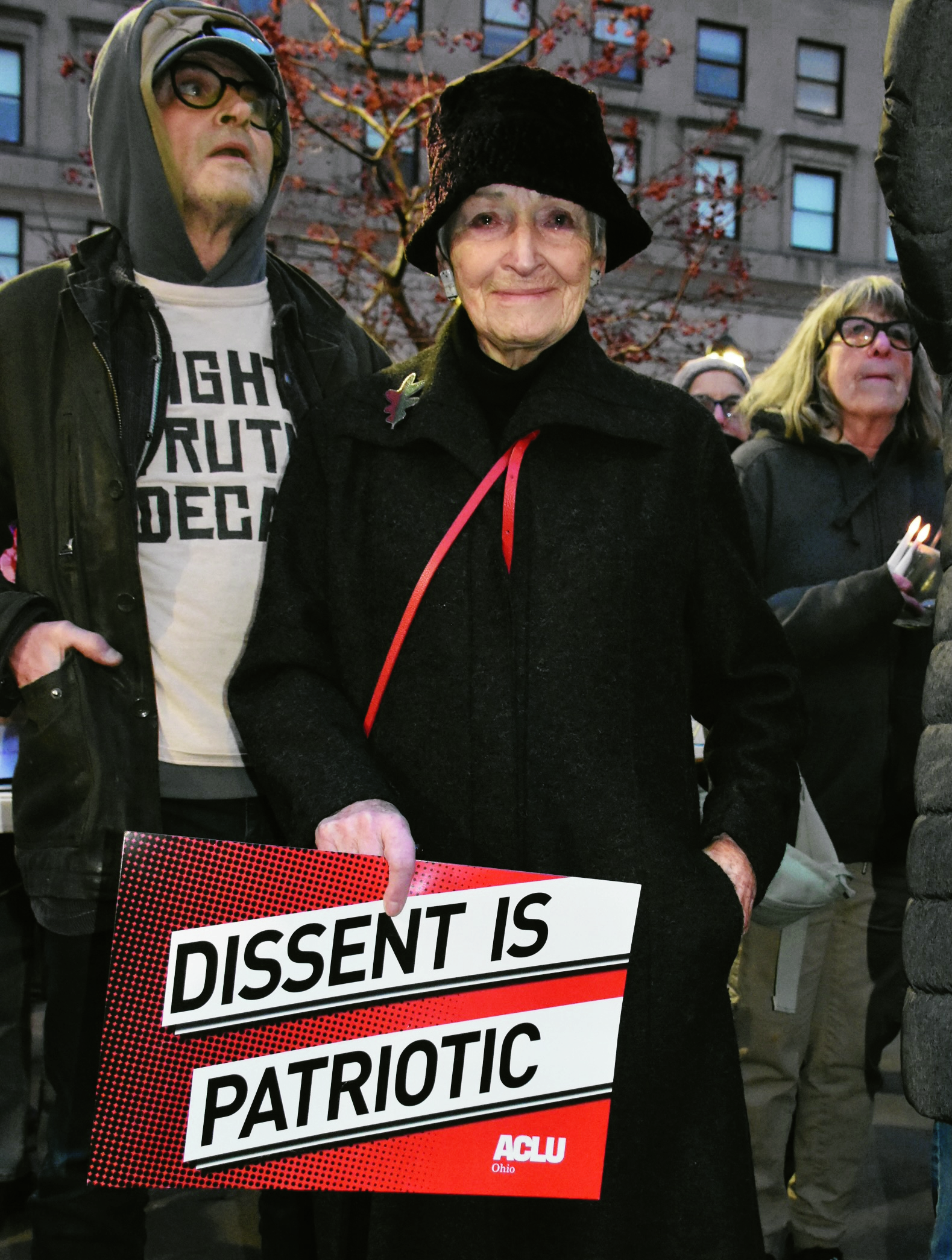
Friday, January 9, 2026; Candlelight vigil in memory of Renee Good, Market Square Park, W. 25th and Lorain Avenue: This woman expresses her patriotism through protest.
by Lynette Filips
The sign on the side of the building at 2929 Richmond Rd. in Beachwood says “Maltz Museum of Jewish Heritage”, but since its founding in 2005, the Maltz Museum has demonstrated that it’s also interested in much more than Judaism. That’s largely been shown through the wide scope of the Museum’s special exhibits, and its relatively recent nomenclature change to “Maltz Museum for All Humanity”.
The current special exhibit, which will be wrapping up a five-month run on Monday, February 16th (Presidents Day), is a good example of how the Maltz Museum highlights the struggles of oppressed peoples across multiple cultures.
“El Sueño Americano/The American Dream” is the brainchild of American photographer-artist Tom Kiefer. It’s been traveling to venues across the United States since 2018, but this showing in Cleveland is the first time that it’s being displayed with pieces by Mexican artist Elizabeth J. Pineda.
Kiefer got the idea for the presentation while he was living in Azo, a city in southwest Arizona, and working part-time as a janitor (2003-2014) at the United States Customs and Border Control facility there. After about four years of seeing massive amounts of shelf-stable food confiscated from the migrants and thrown into the garbage, he asked for — and was granted — permission to donate it to local food pantries.
In the process of sorting through the trash for salvageable food items, Kiefer noticed all the other personal items which the agents had seized from the migrants… and then promptly discarded. The agents said that they were “non-essential” or “potentially lethal” but Tom Kiefer didn’t view them that way. He viewed them as the American government’s attempt to dehumanize the desperate people who’d packed the most important items from their lives into a backpack and risked life itself to cross Arizona’s killer Sonora Desert for a week (or more) in the hope of reaching a perceived better life in the United States.
If they survive the Desert, what they encounter at the border is the opposite of what they hoped for, as well as the opposite of what earlier generations of immigrants encountered (ideally at least) at Liberty Island in the waters outside of New York City.
“El Sueño Americano…” opens with the words of poet Emma Lazarus at the base of the Statue of Liberty written in English, French and Spanish with alphabet soup macaroni letters —
Give me your tired, your poor,
Your huddled masses yearning to breathe free,
The wretched refuse of your teeming shore.
Send these, the homeless, tempest-tost to me,
I lift my lamp beside the golden door!
Next there is a huge display of black water jugs, specifically designed for the Desert crossings, and then begin Tom Kiefer’s photographs.
The photographs are artistic arrangements of items in the migrants’ backpacks which Kiefer rescued from the garbage: Clothes like extra pants and shirts/tops, underwear, socks and shoes, shoelaces, belts, hoodies and gloves; Food like little cans of tuna fish, jars of peanut butter, candy bars, milk, yogurt drinks and energy drinks; Toiletries like hair brushes and combs, toothbrushes and toothpaste, bars of soap, rolls of toilet paper, nail clippers, deodorant, cologne and make-up; Religious items like rosaries, holy cards, pocket-size New Testaments, necklaces with crucifixes or images of Our Lady of Guadalupe and small statues; Children’s play items like small toys and stuffed animals; Intensely personal items like photos of loved ones, diaries, wallets with the IDs still inside, money, cell phones, CDs, rings, keys, medicine, condoms and female contraceptives; blankets, notebooks and needles with spools of thread.
There is a photo of muddy yellow rubber duckies which migrants purposely leave in the Desert to mark the route for subsequent migrants; and another photo of newspaper articles about noteworthy tragedies which occurred there. There is also a short documentary film playing in the theater in the exhibit area.
Elizabeth Pineda’s work is at the end of the exhibit. Born in Mexico City, she now lives in Surprise, Arizona. The purpose of her work is to memorialize the thousands of migrants who died in the Desert on the way to America. It begins with a film, “Ceremonia”, of her sitting at a typewriter, saying out loud the name (or no name) of each person who perished. Then she types that individual and location of death onto a long panel of silk — “Sin Nombre in Esta Tierra Sagrada” (Nameless in This Sacred Land).
The volumes of artfully hung silk panels are in the next area and titled “Reverencia”. There are so many typed entries in such small type that it is nigh impossible to read even one line of it, but the idea of the overwhelming number of human beings who have lost their lives in the Sonora Desert comes across.
The final segment of Elizabeth Pineda’s art is “Maíz” — a series of cyanotype prints of traditional cooking herbs on corn husks.
In addition to its rotating special exhibit room, the Maltz Museum has two permanent exhibits — The Temple-Tifereth Israel Gallery (one of America’s largest collections of Jewish art and Temple artifacts) and the American Story (about Jewish life here). There is a large lobby for special events and a gift shop off the lobby.
The Museum is generally open Tuesday through Sunday from 11 a.m. to 5 p.m. Under the “Museums for All” program, admission is free for individuals and families with Supplemental Nutrition Assistance Program (SNAP), Electronic Benefits Transfer (EBT) or Women Infants and Children (WIC) program cards. Call 216-593-0575 to reserve tickets and be sure to bring the card and a photo ID the day of the visit.
Admission to the Maltz Museum will be free for everyone on Presidents Day. Otherwise, admission is $12 for adults, $10 for seniors and students over the age of 12, and $5 for children ages 5 -11. Children 4 and under are free.
Beachwood is not as far away as it sounds and can be easily accessed via just two roads from the west side of Cleveland — Take Denison east (its name changes to Harvard on the other side of the Cuyahoga River) and then take Richmond Rd. north (a left turn off Harvard.) The Museum will be on the right at 2929 Richmond Road. Or take the highways if you prefer. The important thing is to experience this exhibit.


Leave a comment