PHOTO BY COREY MEADOR
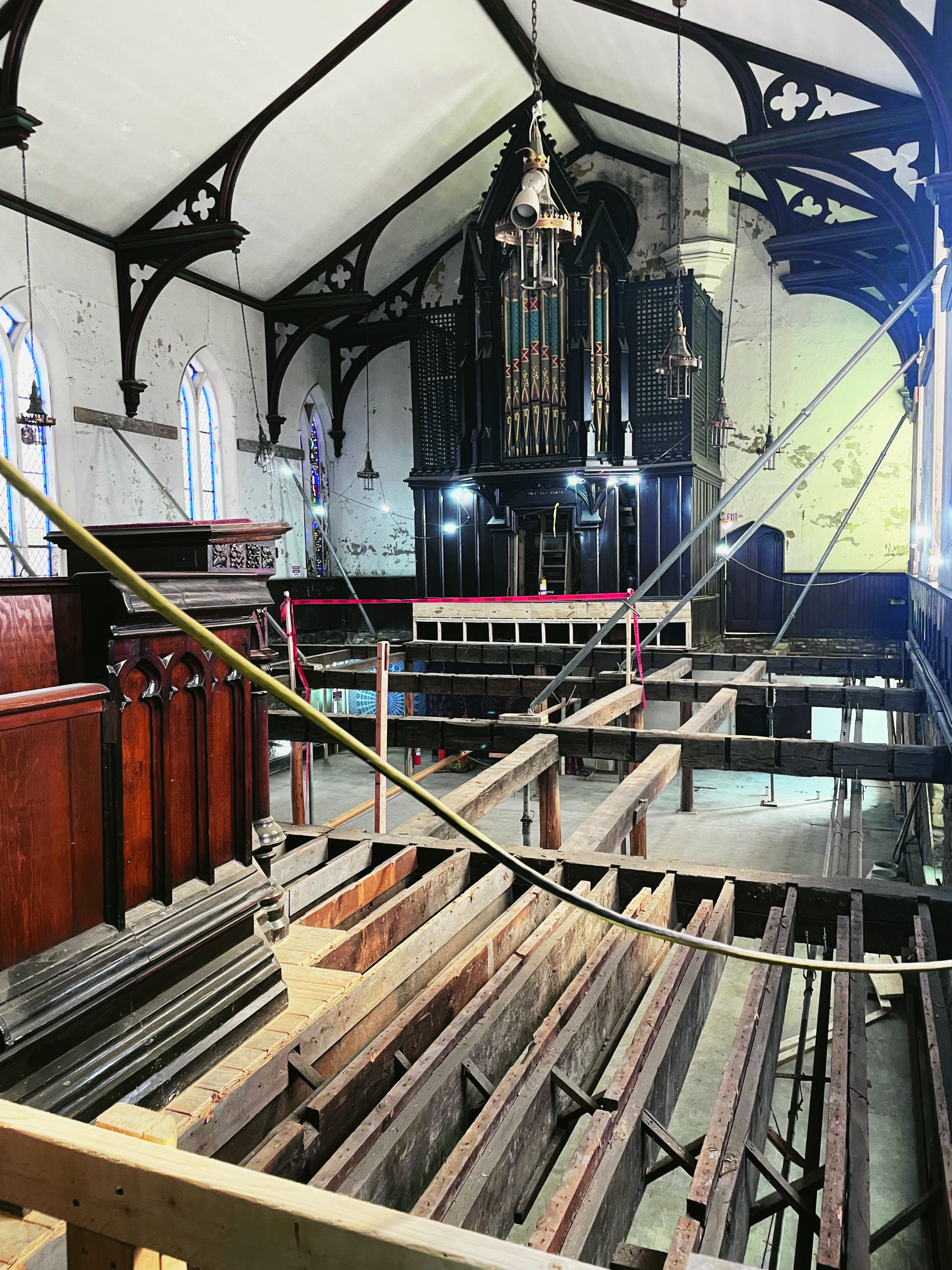
St. John’s Episcopal Church, 2600 Church Avenue: Renovations are underway inside the sanctuary.
by Corey Meador
(Plain Press June 2026) A $400,000 project underway at St. John’s Episcopal Church sparks new life and opportunity into Cuyahoga county’s oldest consecrated building. On Church Avenue in the Hingetown neighborhood of Cleveland, many pass St. John’s Church without realizing its significance. St. John’s, completed around 1836, is a national historical landmark because of its role in the underground railroad. It is the third oldest building in Cleveland, behind Dunham Tavern and a private residence in Old Brooklyn.
The floor, seen to be sagging some 75 years ago in the middle of the 3,500-4,000 sq foot space, is finally being replaced. Cleveland Public Theater organizers of the annual Station Hope event, held in the church, pointed out the bowing floor beneath the pews, concerned about its stability. This prompted the Board of the Episcopal Diocese, who own and operate the church, to obtain an inspection which judged the floor unsafe for more than 10 people. The repair was made a priority and is propelling plans to re-envision the role of the church in the community. Rebecca Miller, the Episcopal Diocese Commissioner for Operations said, “Station Hope is really important to continue. And the fact that it was not able to happen last year really was disappointing for all of us. We’re working hard to make sure that that can happen in the future and that it doesn’t get lost. At this point, we’re focused on the current project and putting together the right team of people to discern what’s next.”
In keeping up with the neighborhood’s transformation in the last decade, Tom Hill along with the other 5 trustees of the Diocese Board are spearheading this effort of discernment.
The nuanced approach of the Diocese tending to this landmark building differs from Dunham Tavern in that St. John’s is just one of 76 parishes the Episcopal Diocese presides over. The Diocese is dealing with a few of their own parish closings in recent times. According to Hill, “The model of the church for the last few hundred years has been: you have parish churches set in the centers of towns, built of stone, and they have massive edifices, and they’re used once a week. The model for the church going forward has to evolve. The parish ministry is still a key part of what we do, but the community of faith can be defined in many different ways, and I would see [St. John’s] becoming some sort of faith community that honors the heritage of the building, that honors the African American experience in the United States, and even can be more than that.” He added, “We’re not going to sell this place. We’re not going to let it be condos. It’s too historical.”
It’s an exciting time for them, as they shore up the floor and begin engaging the community for the future of the building. Hill says, “We have funds that we were able to pull together for this particular project. But going forward, we’ll need to really understand what it’s going to be. When we partner with someone or something, some entity, nonprofit, the City, whomever, once we decide what this is going to look like, we’ll be able to find out what it will need.”
The removal of the original pews in the church, sending all but two of the pews to RBX to be recycled, renders the church floor wide open making the future use of the space more versatile. In the spirit of the Diocese’s open-minded approach to what St. John can become, Hill says, “If we put pews back in, it can only be a church. And it needs to be more than that.”
The current use of the space includes block club meetings and yoga classes, temporarily being held in the adjacent Chapel. They expect the floor replacement to be complete by the end of April. “We’re excited about what this space could be and are looking for partners to reimagine the space to meet the needs of the community,” says Rebecca Miller.
Part of the responsibility of those who own historical landmarks is to maintain the foundation and the historical character. Dunham Tavern Executive Director Lauren Murray says, “it’s very expensive to care for these old buildings.” She points out, “that goes hand and hand with you having a building that is 200 years old and you have to maintain that.” That maintenance is a large portion of their operational budget.
Unlike Dunham Tavern, the Diocese absorbs the operational costs of St. John’s with no major fund raising, grants, or recent donors. Future projects at St. John’s may necessitate alternative sources of funding. For example, they received a quote to repair the stained glass at St. John’s for $500,000.
Another large cost would be to repair the interior of the belltower. What used to be a place where runaway slaves found refuge and peered out of the windows waiting for light signals from boats ready to bring them to Canada, is a structure now deemed unsafe to ascend. The Diocese has no plans of any interior modifications or repairs to the church beyond getting the floor and thus the building functional, i.e. open for business. Tom says, “the biggest help that we can use right now is for people in the community to let us know what they want this to be, what this could become.”
 Plain Press
Leave a comment