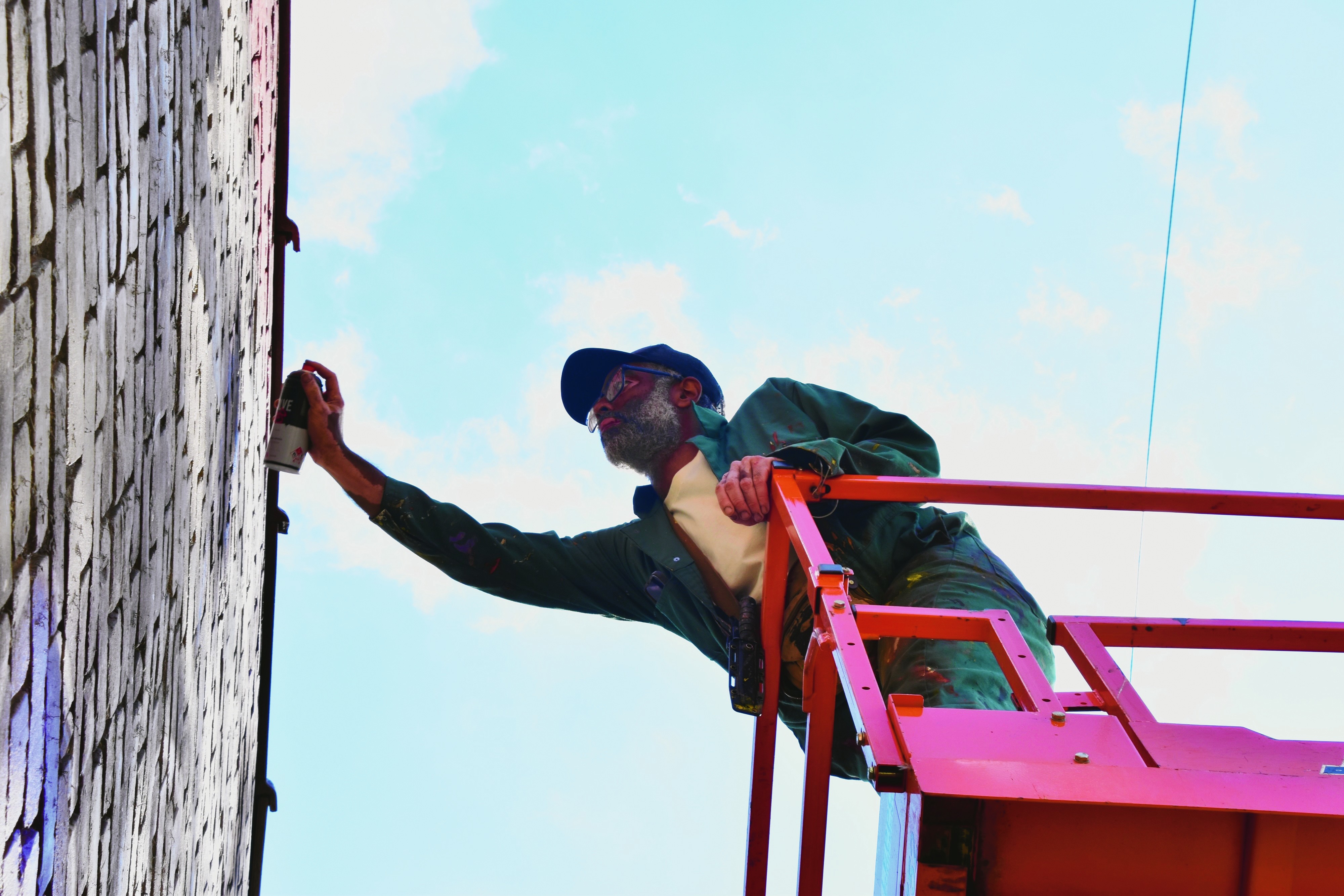
PHOTO BY ANASTASIA PANTSIOS
September 6, 2025; The Art Garden Project, W.50th and Storer Avenue: Cleveland-based Dominican artist Ariel Verges (also known as BlackBrain), paints a mural. The Art Garden Project is a large-scale community initiative, on Storer Avenue and nearby neighborhoods, catalyzed and funded by the city’s Transformative Arts Fund (TAF).
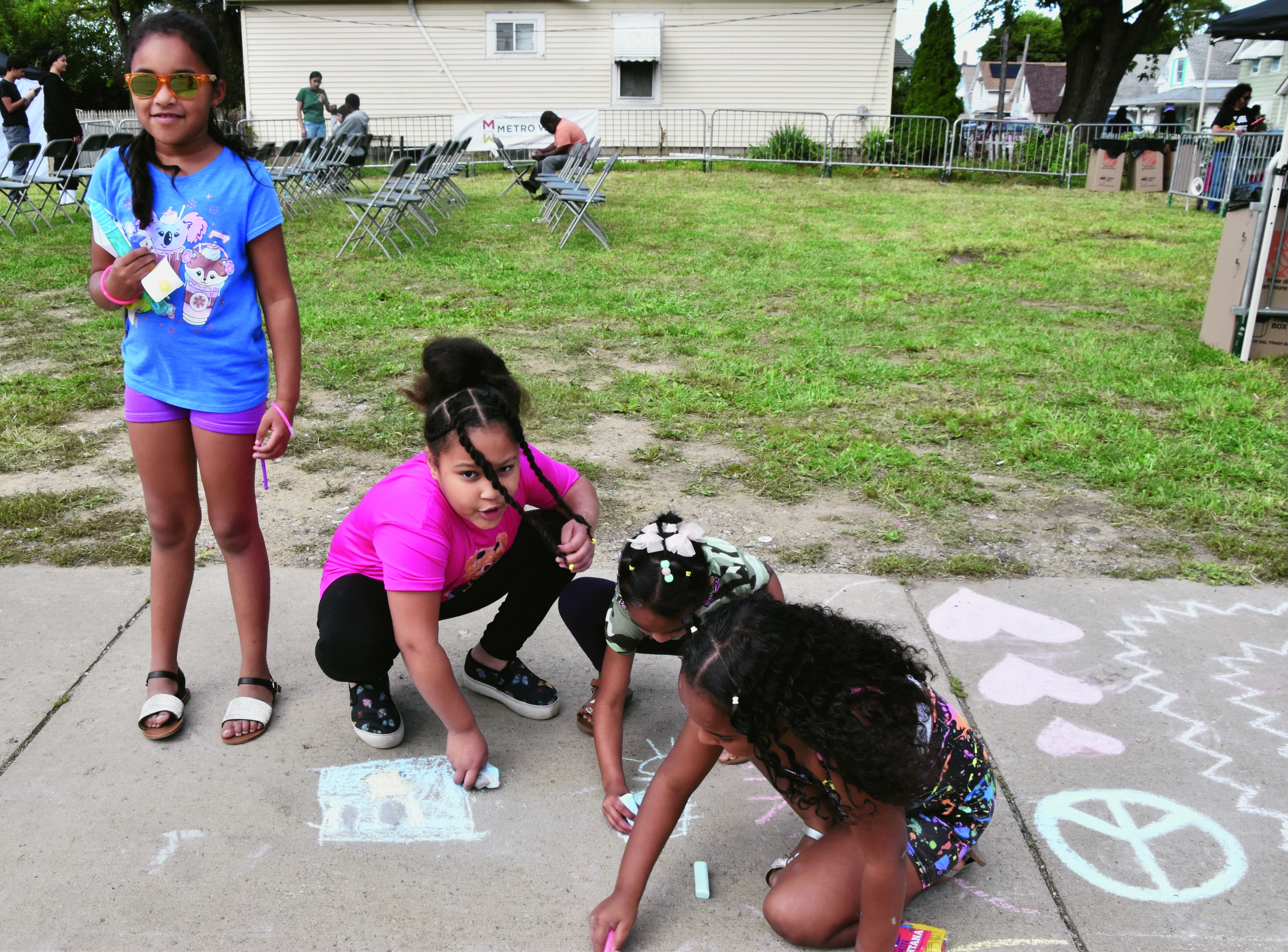
PHOTO BY ANASTASIA PANTSIOS
September 6, 2025; The Art Garden Project, W.50th and Storer Avenue: Children create chalk art on the sidewalk in the Kids Art Garden.
by Bruce Checefsky
(Plain Press June 2026) The City of Cleveland spent $3 million of one-time ARPA (American Rescue Plan Act COVID relief) money on a project called the Transformative Arts Fund (TAF). Through this project, the City promised to transform underserved neighborhoods through arts projects. But the City is leaving the public in the dark about how and where the money was spent. Critics of the program found the projects hard to access, and no one seems to know what, if anything, the projects left behind.
Midway through her hour-long final report to the Health, Human Services, and Arts Committee (HHS&A) meeting at City Hall on April 27, Rhonda Brown, Cleveland’s senior strategist for arts, culture, and the creative economy, said, “The institutional partner retains all financial records and receipts.” She then repeated the statement, adding, “They are contractually accountable for spending the funds.”
Brown was responding to multiple requests made by local news agencies and individuals for public records requests surrounding the Transformative Arts Fund project. The response has been slow, if not stagnant.
While the City of Cleveland, along with Assembly and LAND studio, managed the program, the “institutional partners” were various community organizations and institutions, each assigned to support a specific artist-led project.
CoolCleveland made a public records request as early as November 2025 and got no response. Requests were made again in April and March, which included asking for a list of the 400 artists the City claims benefited from the program. The location and dates of the performances and public installations for the 600 new artworks they say were created during the year-long program have yet to be verified. City spokesperson Tyler Sinclair eventually released over 200 pages of contracts and spreadsheets but failed to release the full request.
Axios Cleveland encountered a similar issue when attempting to report on the grants shortly after they were announced in 2024. Applications and scoring documents came back eight months later with no responsive records, according to the news publication. Reporting has been inconsistent, and public records have been withheld. A lack of monitoring of institutional partners is apparent. Standardized terminology and basic requirements, including conflict of interest policies and public notices, have not been released.
Oddly, on the same day “Tax-Funded Arts Program Raises Questions” appeared in CoolCleveland, on March 19, Brown sent a memorandum to Margarita Mason, an administrative assistant responsible for handling contracts and purchase requisitions, among other tasks, making it clear that the institutional partners were responsible for bookkeeping, not the City. Assembly for the Arts was responsible for oversight and administration.
“Any questions regarding the specific expenditure of funds at the project level must be directed to the institutional partner of record for each project,” wrote Brown. “Institutional partners are the official grant awardees, and their financial records constitute the primary documentation of record for each project. Assembly for the Arts should be contacted for questions regarding overall program administration.”
Brown directed the seven institutional partners involved with the TAF project to retain “source documentation in support of their expenditures, including but not limited to executed contracts, vendor invoices, receipts, canceled checks, and proof of payment.”
Jeremy Johnson, president and CEO of Assembly for the Arts and fiscal agent for the TAF project, was copied on the memorandum. Johnson could not be reached for comment.
Requests were made for information on project transactions and applications, quarterly progress reports, meeting notes, and payments to artists. Brown’s job description and salary were added to a recent records request, along with an explanation for why artists were required to sign a nondisclosure agreement (NDA), a point of confusion for many in the community. Whether NDAs can be used on federally funded ARPA projects depends, according to the U.S. General Services Administration, but they cannot lawfully conceal expenditures of public funds or award criteria.
CoolCleveland obtained a copy of the NDA issued by the city. The single-page document states that any member of the Transformative Arts Fund Program Arts Committee and/or Transformative Arts Fund awardee, applicant, institutional partner, and/or project administrator or contractor “agrees that any and all information related to the Transformative Arts Fund, including but not limited to deliberations and the selection of artists under the program and pre-award planning and execution shall remain strictly confidential and will not be disclosed to third parties outside of the TAF Arts Committee, staff, and/or other TAF planning administrators prior to the City of Cleveland announcing the awardees.”
Several legal experts agree that since the City announced the seven awardees for the $3 million project in July 2024, the restrictions of the agreement no longer apply, which raises questions about the embargo on public information from the City and the Assembly.
Following Brown’s presentation, a request for records was sent to all seven institutional partners: The Sculpture Center, Ingenuity Fest, Cleveland Clinic, RedHouse Studio, Cuyahoga Metropolitan Housing Authority, MetroWest Community Development Organization, and Campus District.
Emily Lee, executive director of the Metro West Community Development Organization, responded with a single-page list of transactions. Among the transactions were payments to Reishi Studio, Inc., founded by Ariel Vergez, the lead artist for the Art Garden project, totaling more than $333,460. Two murals cost $69,632, and the remaining amount was listed as “grant funds for art project.” She also offered to provide receipts.
None of the other institutional partners has responded at the time of this article.
Sources close to the TAF project report that a third-party evaluation is underway. Neither the Assembly nor the City confirmed or denied any involvement.
Despite failed attempts to access the records, a list of questions was sent to Councilman Austin Davis, vice chair of the HHS&A committee, at his request and prior to the meeting. The list included providing documentation that backs up the numbers included in the report and listed on the City’s website. But Davis failed to ask any questions. Neither did councilpersons Kevin Conwell, Kris Harsh, Nikki Hudson, or Tanmay Shah.
As the meeting ended, Ward 1 Councilman Joe Jones asked to see a list of murals and their locations. “I want to see all of these spaces,” he said. “I could not find the locations in your presentation. Do you have that somewhere?”
“The exact locations are not in the report,” said Brown, adding, “I would be happy to provide that to you.”
Article provided courtesy of CoolCleveland


Leave a Reply