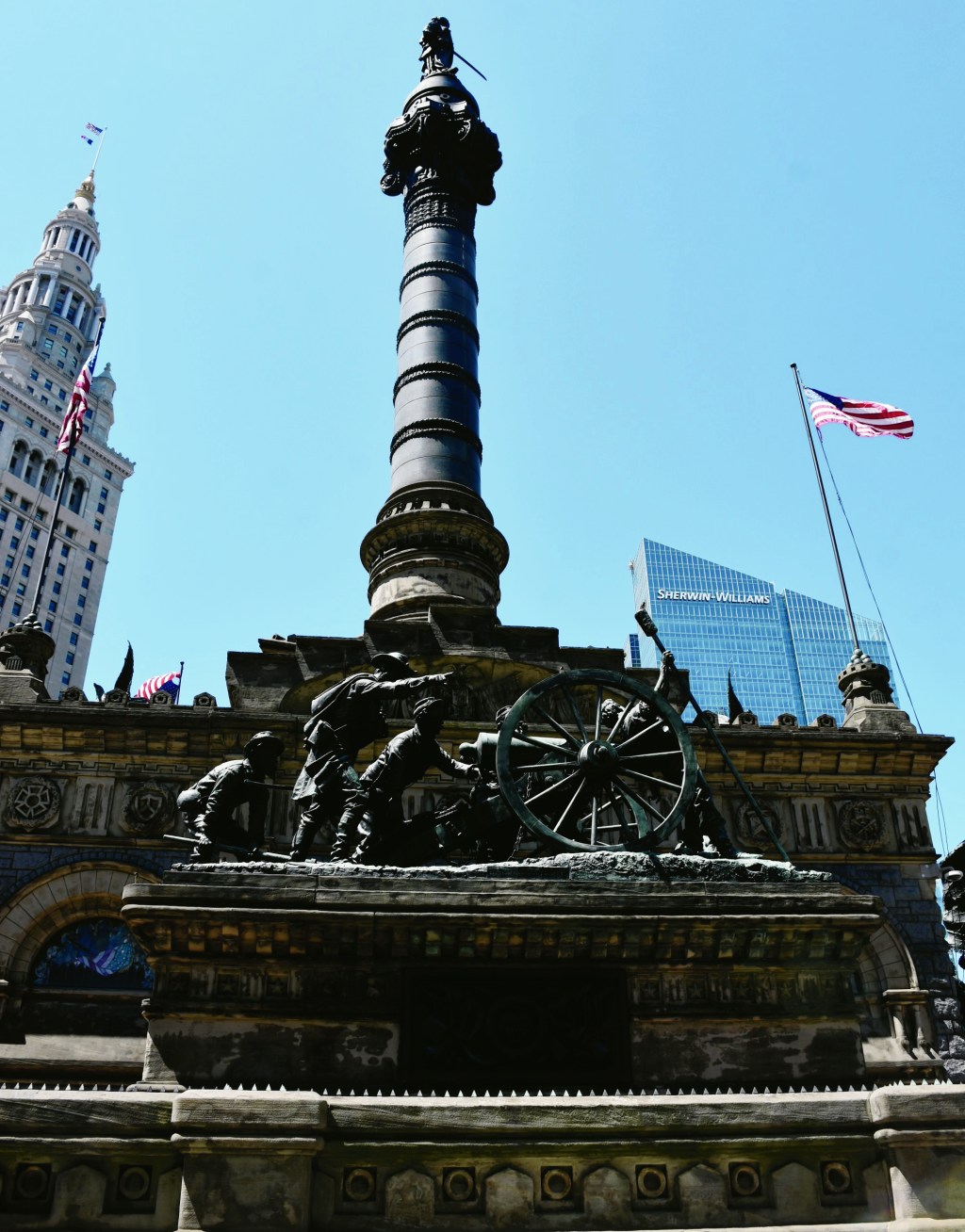
The Cuyahoga County Soldiers’ and Sailors’ Monument celebrated the Juneteenth Federal Holiday on June 19th.
Soldiers’ and Sailors’ Monument Executive Director Greg Palumbo offered those touring the Monument some of the history of Juneteenth. He read General Order Number 3, which announced that all enslaved persons were free. The Order was issued by Union Major General Gordon Granger when he arrived in Galveston, Texas on June 19, 1865. The news came to enslaved persons in Texas two and a half years after President Abraham Lincoln issued the Emancipation Proclamation to free slaves.
Palumbo said the Emancipation Proclamation was enforced when the military took locations. Confederate resistance was maintained in Texas even after General Robert E. Lee surrendered his Army of Northern Virginia to General Ulysses S. Grant on April 9,1865. The surrender of the last contingent of the Confederate Army in Texas happened just two weeks before General Order Number 3 was issued.
Palumbo read the short General Order Number 3 to guests touring the monument. The Order said, “The people of Texas are informed that, in accordance with a proclamation from the Executive of the United States, all slaves are free. This involves an absolute equality of personal rights and rights of property between former masters and slaves, and the connection heretofore existing between them becomes that between employer and hired labor.”
Palumbo said the hope in General Order Number 3 was that in creating a new relationship of employer and hired labor that former slaves would be able to accumulate resources and not become destitute. Palumbo said it was up to the Union Army to enforce this rule.
It took the ratification of the 13th and 14th amendments to the Constitution to solidify what was stated in the Emancipation Proclamation, said Palumbo.
Palumbo then shared some history of the Soldiers’ and Sailors’ Monument and the involvement of Cuyahoga County residents in the Civil War. The Monument, he noted, is dedicated to the over 9,000 individuals from Cuyahoga County that served the Union in the American Civil War. Palumbo noted that was a large portion of the population of Cuyahoga County. At the time the Civil War began, the County’s population was estimated at 78,000 people. Palumbo says the 9,000 individuals’ names on the walls of the monument represent those from Cuyahoga County that enlisted locally. The Monument staff are still doing research and adding names of those Cuyahoga County residents that enlisted directly as Federal troops. This list includes 107 names, some of which are former slaves that enlisted after the Emancipation Proclamation.
The architect and sculptor of the monument, Levi T. Scofield, was a veteran of the Civil War. Scofield served as a Captain in the 103rd Ohio Infantry Regiment. Scofield donated his work on the Monument, refusing to take any compensation, said Palumbo. The program passed out at the celebration indicates that Elizabeth Scofield, the wife of the architect, “led the compilation of the 9,000 names inside.”
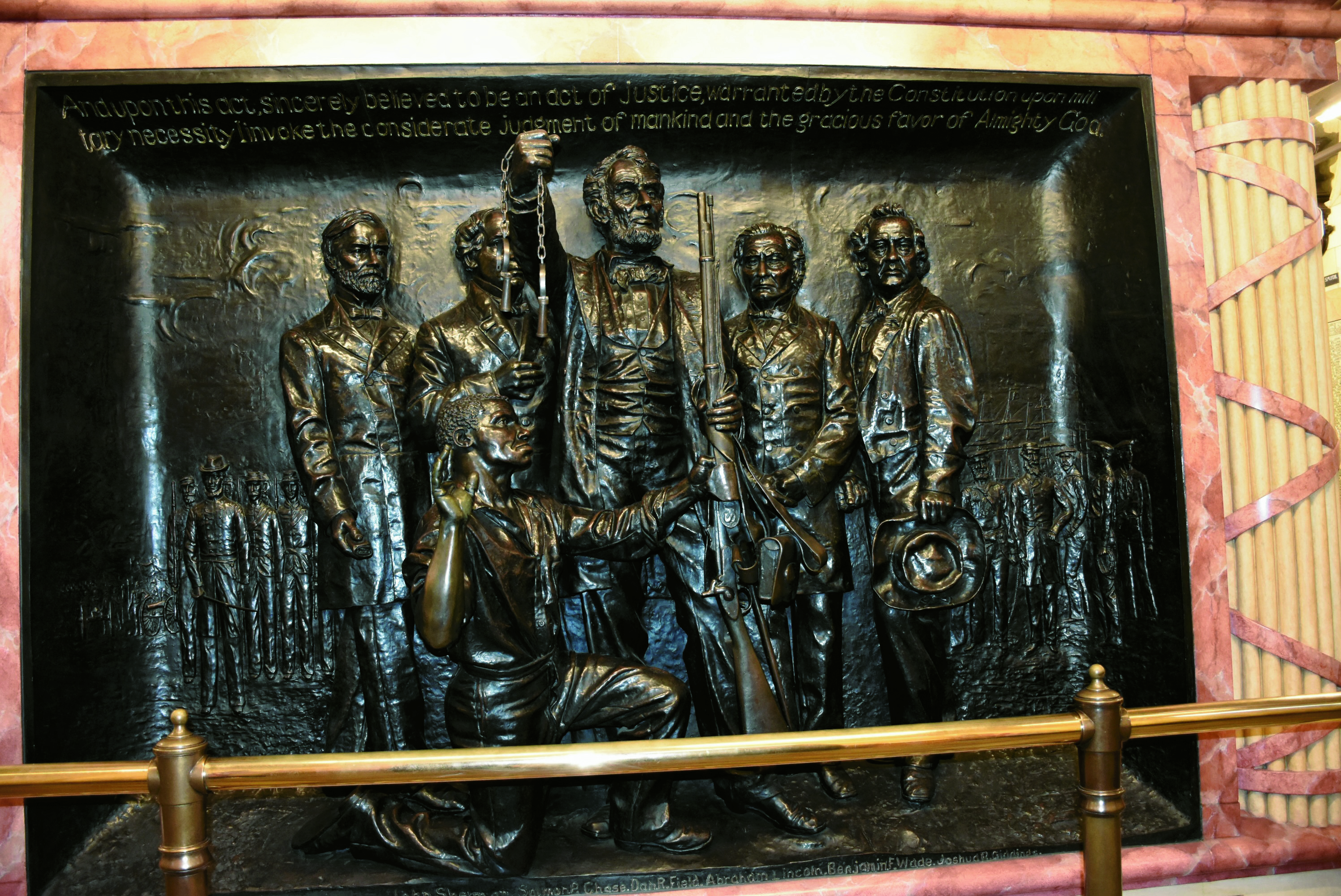
The tour of the interior of the Soldiers’ and Sailors’ Monument led by Palumbo included a look at four panels. According to the program, one panel, Northern Ohio Soldiers’ Aid Society and Sanitary Commission, features the women from those groups that “sent over a million dollars’ worth of resources to soldiers on the front lines.” A second panel, titled Beginning of the War, features Ohio Governors during the Civil War and generals who were from Ohio or commanded units from Ohio. It also shows civilians signing up to serve in the war on one side and leaving in uniform on the other side. A third panel, titled The Emancipation of the Slaves, features President Abraham Lincoln holding shackles representing the freeing of the slaves in one hand and handing a rifle to a newly emancipated man joining the Union Army. Standing behind Lincoln in the panel are four major Ohio abolitionists. The final panel is tiled Peacemakers at City Point. It features President Lincoln with the Union generals toward the end of the Civil War.
Palumbo says, The Emancipation of the Slaves panel was considered by Civil War veterans to be the most important of the panels at the time of Monument’s creation in 1894. Veterans wanted the message of the panel to be front and center. Palumbo said that for many years when most people visited the Monument by streetcar, they came into the Monument from the North side, and The Emancipation of the Slaves panel was the first thing they saw when entering the Monument. Now the main entrance is on the south side, as most people come from that direction to visit the monument.
The Cuyahoga County Soldiers’ and Sailors’ Monument is on the southeast quadrant of Public Square in downtown Cleveland. Admission is free. The exterior of the monument is open to the public. From Memorial Day through Labor Day the interior is open every day from 10 a.m. to 5:30 p.m. During the rest of the year, it is open from Tuesday through Saturday from 10 a.m.- 5:30 p.m. For more information visit www.SoldiersandSailors.com.


Leave a Reply