CPP ADMITS WEAK INFRASTRUCTURE AND LACK OF MAINTENANCE UNDERMINE THE ABILITY TO PROVIDE POWER
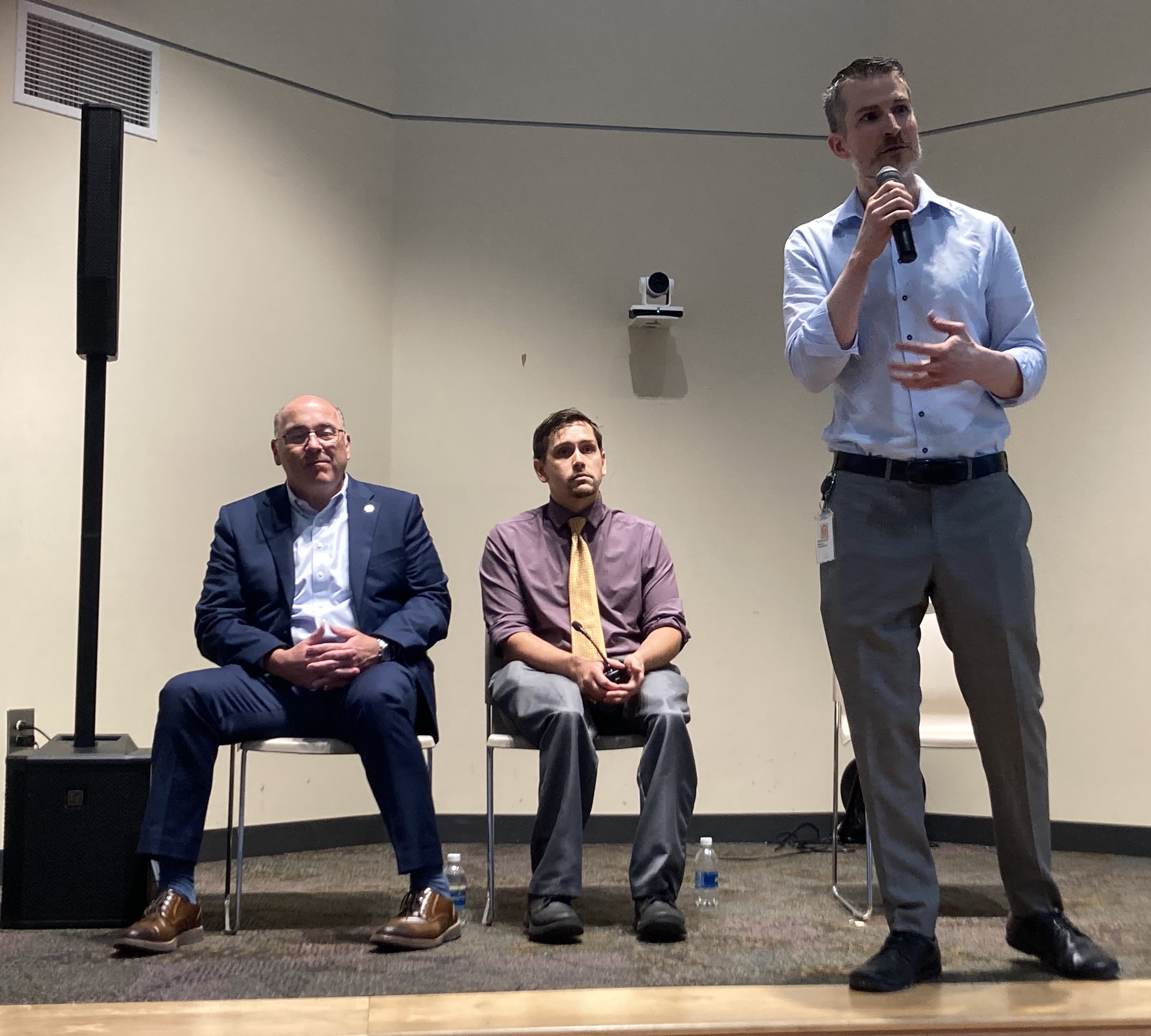
PHOTO BY BRUCE CHECEFSKY
Wednesday, July 21, 2026; Urban Community School, 4909 Lorain Avenue, community meeting on recent power outages: (R-L) Cleveland Public Utilities Department director Martin Keane, Ward 7 Cleveland City Councilman Austin N. Davis, and Cleveland Public Power (CPP) Commissioner Ammon Danielson.
by Bruce Checefsky
(Plain Press August 2026)To residents of Cleveland’s Near West Side, including Tremont and Ohio City in particular, power outages have become an unwanted weekly, if not daily, disruption. Outages have kept businesses closed and residents scrambling to charge their phones and computers, power household appliances and HVAC systems during record-breaking cold weather and heat waves. But according to Cleveland Public Power (CPP), the problem is not an easy fix.
In a town hall meeting to address the widespread power outages, about fifty residents listened as CPP Commissioner Ammon Danielson detailed events that led to the massive July 4 outage. He confirmed that a century-old infrastructure, combined with deferred maintenance, including foregoing repairs and needed upgrades, has led to the rash of power outages.
The most recent widespread outage affected tens of thousands of customers over the holiday weekend, with some outages lasting up to 52 hours. More than a dozen restaurants and local shops in the Lorain Avenue neighborhoods reported significant financial losses from spoiled food and inventory.
“We had a substation go offline on July 1,” said Danielson in a meeting that lasted about ninety minutes. “When everyone is running their AC units all day, day after day, we see more and more problems.”
Crews repaired the substation and service went back online the same evening. CPP struggled to reroute power from different areas while still having enough power for their customers unaffected by the outage, he said. But by later that week, residents on the near West Side felt the effects of a drop in electrical voltage, called brownouts, along with complete outages as temperatures rose to a record-shattering 97°F on July 1, followed by several days of at least 90°F.
“On top of the heat, we had an extra demand on our underground cables feeding the substation,” explained Danielson, “and around midnight, one of those cables failed. Another one failed an hour after that, about 1 AM, causing a cascading effect of failures.”
Underground cables are less able to dissipate heat, and the heat from the cables, not from the outside temperatures, and because of the demand, caused the failures, according to Danielson. As more loads failed over the cables, other cables were strained. Fixing the problem is difficult. CPP has to locate exactly where the failure is, street by street, remove the damaged cable, and pull a new one.
“Each of these steps could take hours. It is not as easy as seeing a tree that fell on a line,” he said.
High temperatures and storm damage stretched their resources. CPP crews worked all week on a variety of problems and situations. Outside contract crews were brought in for support. Scattered pockets of underground failures were exceedingly difficult to identify. Plus, the infrastructure kept failing.
In 1890, a social activist group petitioned City Council to create a municipal utility to run electrical wires underground to serve Cleveland residents. Mayor Tom L. Johnson supported the activists’ recommendation sixteen years later, and soon after, the first-generation CPP was online. Some of the equipment dates back that far.
“We have an old distribution system with issues going back to the early 1900s. Infrastructure is expensive, and unfortunately, we are dealing with a history of deferred maintenance. My goal is to change that,” said Danielson.
Municipal-owned utilities like CPP are not-for-profit entities owned by local governments. They provide essential services, including electricity, water, and sewage, and generate or purchase energy at wholesale rates to better serve their customers. CPP is governed by the City Council, which sets the rates to cover the cost of operations, maintenance, and system upgrades.
Historically, CPP electricity rates were lower than FirstEnergy’s Illuminating Company. Expensive long-term wholesale contracts align the two utility companies’ rates. Except now, CPP adds an automated PCA (Power Cost Adjustment) rider fee that can double a customer’s standard usage rate. As a not-for-profit municipal utility, customers cannot shop the open market for cheaper rates. They are completely locked into the city’s set pricing.
Denise, from Ohio City, said an outage last April damaged her electrical system. “Outlets were not working. Lights flickered. I had to pay an electrician to fix them. It was expensive. I am frustrated. As a homeowner, it cost me a lot on top of paying my monthly bill to CPP.”
She asked whether the acceleration of real estate development in the area, with new apartments and condominiums sprouting up on vacant lots almost overnight, pulled electricity from the neighborhoods, causing the blackouts.
Danielson explained the onboarding process for new projects, which included a capacity assessment to ensure the loads get met while maintaining service to the area. Existing residential areas have branch lines that feed off a specific meter; larger development projects, including apartment and condominium complexes, are supplied with transformers. “The capacity for the large apartments is there and causes no issues for the others,” he said.
Sharon, also from Ohio City, said she moved to Cleveland about a year ago after living in several major metropolitan cities across the country. Power outages have never occurred in those cities as frequently as in Cleveland. “I have never lost power as many times and as many days as I have lost it since last year. I have lost faith in CPP. Every time there is a storm, I am afraid of losing power and how that will affect my next few days,” she said. “I am losing confidence. I want to hear more about what you are doing to fix the problem rather than describing the problem.”
Danielson sighed, then thanked her for the question. “We are working on a strategic plan that will address reliability and reputation,” he said, acknowledging the problem. “I know we need to do better.”
An hour into the meeting, Cleveland Public Utilities Department director Martin Keane was sidelined and checking his phone periodically, while Danielson fielded questions. He finally stood up to say that the Bibb administration fully supports the CPP.
“I do not want anyone to think that the Bibb administration does not support public utilities. It does. We welcome the support and advocacy by City Council as well. But we have to continue to work to keep their support,” said Keane.
Danielson reiterated that “without the Bibb administration and support from City Council, the strategic plan would not happen.”
Ward 7 Cleveland City Councilman Austin N. Davis, who hosted the town hall meeting held at the Urban Community School on Lorain Ave., asked Danielson and Keane when CPP last submitted a strategic plan to the city.
“Can I say no comment?” Danielson replied. “Never.”
Sarah, from the Old Brooklyn neighborhood, who lives with four other family members working from home, wanted to know whether CPP could communicate more often and provide predictions on the length of repair time or even use social media to get their message to their customers. “We are trying to figure out how long our freezers are going to last. Even a time range for repairs helps us make a better plan.”
She added, “We know it will not get fixed tomorrow, but how can we, as a community, work together to support each other? We need to share our resources and talk to each other to find out whether someone has a generator that could store medication, for example.”


Leave a Reply