MOVE ENDS WEST SIDE MENTAL HEALTH SERVICE HISTORY DATING BACK TO 1973
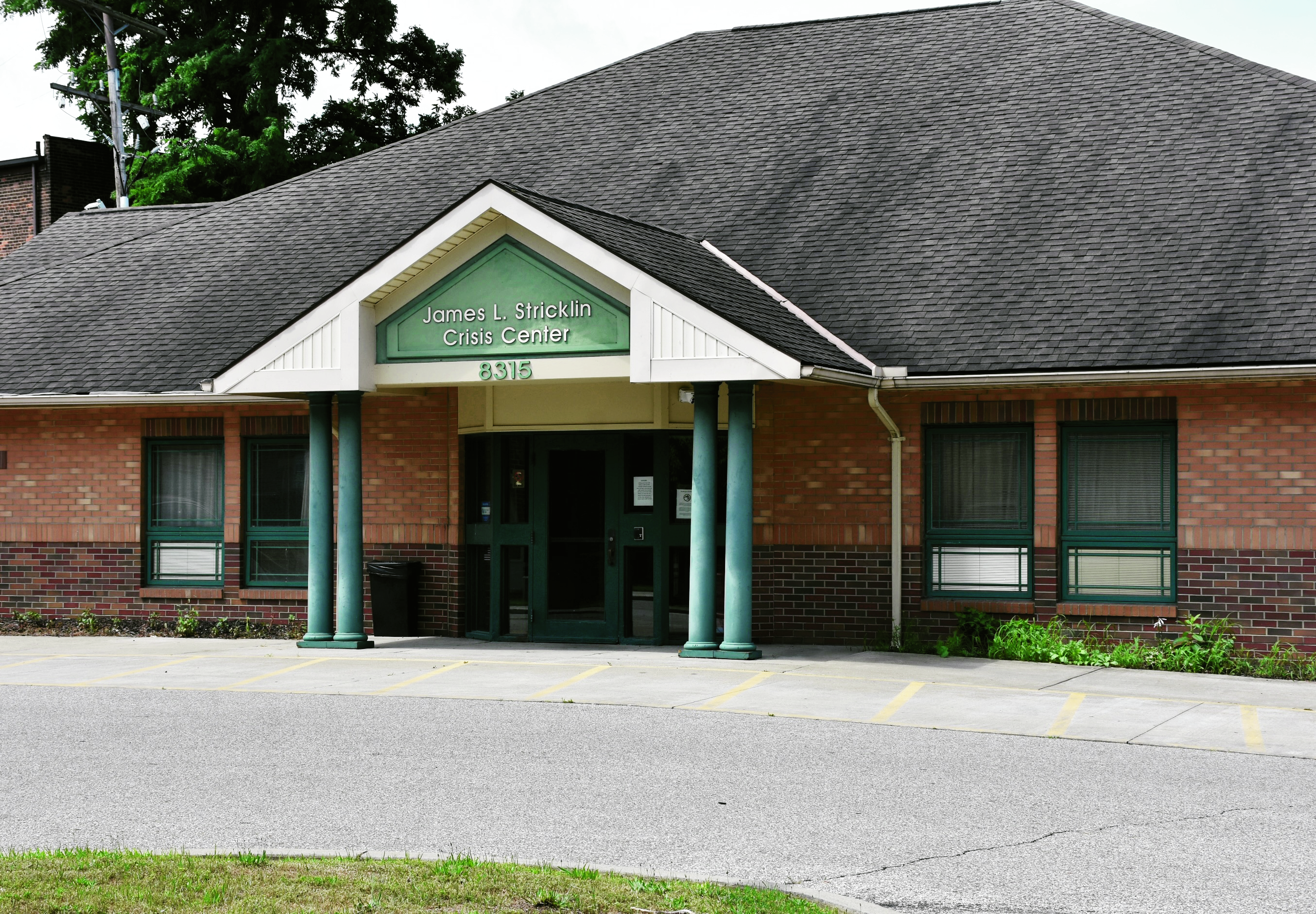
PHOTO BY DEBBIE SADLON
Saturday, July 11, 2026; James L. Stricklin Crisis Center, 8315 Detroit Avenue: This 15-bed short term treatment facility for those experiencing a mental health crisis is slated to close on August 31, 2026. The Stricklin Crisis Center is a program of FrontLine Service.
by Chuck Hoven
(Plain Press August 2026) On July 16th the Alcohol Drug Addiction and Mental Health Service (ADAMHS) Board of Cuyahoga County joined with Frontline Service and The Centers to announce major changes in behavior health crisis services in Cuyahoga County.
The plan calls for the closing of Frontline Services’ James L. Stricklin Crisis Center at 8315 Detroit Avenue in the Detroit Shoreway neighborhood on August 31st. For the past 13 years, Frontline Services ran The Stricklin Crisis Center, a 15-bed short term treatment facility for those experiencing a mental health crisis. Prior to that, the facility was run by Bridgeway.
NEWS ANALYSIS
An article in the May 2012 issue of the Plain Press titled “Agencies work to bridge the gap in services for mental health clients in the wake of Bridgeway’s closing” notes Bridgeway’s closing in 2012 and the ADAMHS Board resuming responsibility for funding its programs. The article shares some of the history of mental health services on the Near West Side. It notes that Bridgeway’s roots stretch back to its beginnings as the West Side Community Mental Health Center founded in 1973. Its long time Executive Director Ralph Fee retired in 2004.
The statement from the three organizations says, “Frontline’s Stricklin Crisis Stabilization Unit has served as a vital part of Cuyahoga County’s behavioral health crisis continuum, providing short-term stabilization for individuals experiencing mental health and substance use crises. The program has offered a compassionate alternative to emergency departments, helping thousands of residents receive immediate care in a therapeutic setting while connecting them to ongoing treatment and recovery supports.”
Services currently provided by the Stricklin Crisis Center will transition to a new Glick Recovery Campus at 2322 E. 22nd Street. The new Glick Recovery Campus will be run by The Centers. The transition plan calls for the Stricklin Crisis Center to stop accepting referrals on August 10th and cease operations on August 31st. The plan calls for new Glick Recovery Campus to open on September 14th.
Securing proper funding for mental health services in Cuyahoga County has been a challenge for years. A March 26, 2026, article about the proposed Glick Recovery Campus in cleveland.com by Kaitlin Durbin titled “New plan keeps crisis center alive – with gaps still to fill” describes some of the negotiations between the ADAMHS Board and The Centers over how the new Glick Recovery Campus would be funded.
The article by Durbin says the agreement between ADAMHS Board and The Centers caps the ADAMHS Board contribution at $4.5 million, instead of the initial $10 million requested by The Centers. The article also says the agreement shifts more financial risk to The Centers, including repaying $6.8 million to the State of Ohio if the project doesn’t meet expectations. The article indicates that while the initial funding request projected the ADAMHS Board would have to cut other behavioral health programs it funds by a projected $12 million dollars a year, the new agreement reduced that amount to $6 million in cuts per year. Apparently the Stricklin Crisis Center has become a victim of the $6 million in budget cuts called for to fund the new Glick Recovery Campus.
A March 2017 article in the Plain Press by Chuck Hoven titled “Greater Cleveland Congregations’ campaign sheds light on deal for Quicken Loans Arena” described Greater Cleveland Congregations proposal for a dollar-for-dollar match be contributed to a Community Equity Fund for every public dollar spent on the expansion of Quicken Loans Arena. The ask at the time was for $160 million in public dollars for Dan Gilbert’s expansion of the arena. The article states that “Pastor Richard Gibson of Elizabeth Baptist Church outlined some of the goals for the fund including building two mental health facilities – one on the East side and one on the West Side.”
Instead of embracing the proposal by Greater Cleveland Congregations, Cleveland and Cuyahoga County political leaders refused to support the effort. Greater Cleveland Congregations and its community partners gathered over 20,000 signatures to place a community equity fund referendum on the ballot. Cleveland City Council refused to ratify the signatures to place the referendum on the ballot. Greater Cleveland Congregations took the case to the Ohio Supreme Court which mandated the City of Cleveland place the referendum on the ballot. When this happened, the Cavalier’s owner Dan Gilbert withdrew his proposal for expansion of the Quicken Loans Arena and the extension of the Cavalier’s lease to 2034.
This withdrawal by the Cavaliers caused political leaders to pressure Greater Cleveland Congregations to withdraw their ballot referendum. Succumbing to pressure from local politicians and threats of donors to stop donations to the congregations, Greater Cleveland Congregations withdrew the referendum from the ballot. In an August 31, 2017, report by Chanel 3 WKYC Studios by Ben Axelrod titled “Greater Cleveland Congregations reaches deal to withdraw Quicken Loans Arena deal petitions” describes the decision. The report states “Greater Cleveland Congregations (GCC) stated that it chose to withdraw its petitions against the Q deal after Cuyahoga County showed a commitment to researching the costs and best practices associated with building a pair of mental health and substance abuse crisis centers which GCC said it ‘has sought throughout its current campaign’”.
In the aftermath of the withdrawal of the referendum Dan Gilbert resurrected the plan to expand Quicken Loans Arena – securing $70 million in local public dollars for the project. The Chief Executive Officer of the ADAMHS Board Valeria Harper said she would hold Cuyahoga County officials accountable to keep their promise of pursuing funding by other means for mental health facilities. Harper died shortly after that and was unable to continue to advocate for the funding.
 Plain Press
Leave a comment