PHOTO BY BRENDA THEURER
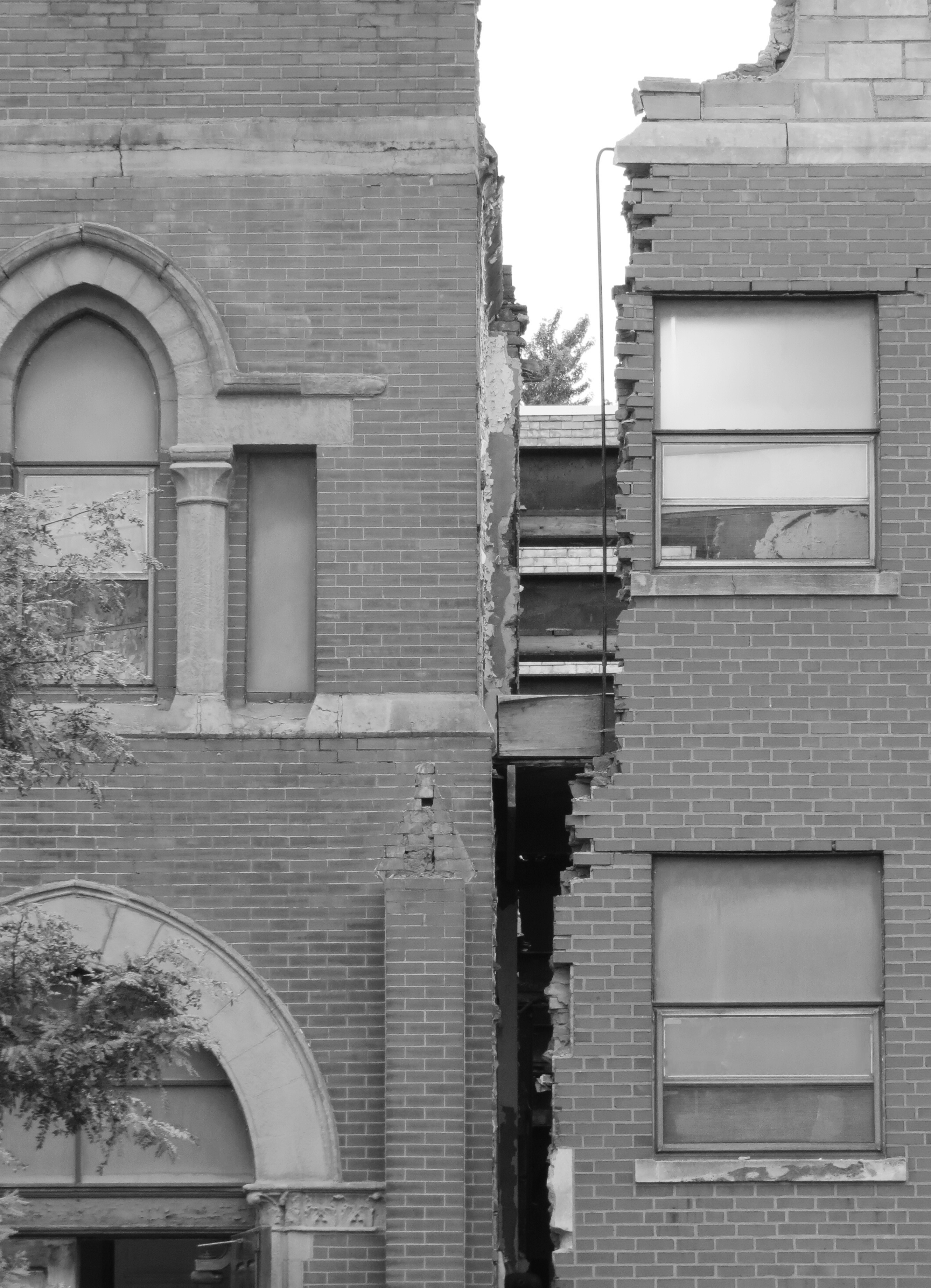
Thursday, August 13, 2026; Northwest corner of Pearl and Memphis: The demolition company’s process of trying to separate St. Luke’s United Church of Christ’s 1903 church building on the left from the 1925 addition —with the parlor, offices and classrooms — on the right. The iconic structure faces Pearl Rd.
by Lynette Filips
(Plain Press September 2026) I don’t know what image makes me feel sadder — the one in last month’s issue of the backhoe in front of Pearl Road United Methodist Church, scooping up the remains of what was once the Greenline Building; or the one in this month’s issue of the gaping split between the two beautiful buildings which were once St. Luke’s United Church of Christ; or the one in my mind of the empty window frame toward the top of St. Luke’s 1925 addition which a three-part stained glass window once filled.
Fortunately, I have some positive thoughts in my mind, too — I’d written to Mary Ann Winkowski (Cleveland’s “Ghost Whisperer” of international fame) about the demolitions at Memphis and Pearl and I received a response from her; The Historical Society of Old Brooklyn (HSOB) has had its holdings moved out of storage and into its new quarters on Broadview Rd.; and David Robinson, the relatively new executive director of the Old Brooklyn Community Development Corporation (OBCDC), reached out to me and has been answering in great detail the questions I have tried to get answered for what seems like a very long time.
First about Mary Ann Winkowski — I am not the only person in Old Brooklyn who has been concerned about the earthbound spirits who have been disturbed by the recent digging and demolitions at Memphis and Pearl. Such spirits are generally known to frequent cemeteries, and they are specifically known to have lived in the c.1860 house behind St. Luke’s which has now been demolished. I further suspected that souls of past members of St. Luke’s were not happy to see their church and the addition to it being hacked apart. So, knowing that Mary Ann is semi-retired and not knowing what I would need to pay her if she even would agree to come to our site, I decided to write to her. I received a prompt, cordial reply stating that she is indeed semi-retired and due to age and health issues with both herself and her husband she had to decline my request for an onsite visit.
But Mary Ann Winkowski did tell me this — Here is what happens when a structure is torn down, burns, or is somehow destroyed. If there are earthbound spirits present, they move on to another location. On their plane of existence, physical attachments do not exist like in our world.
So, it looks like I don’t have to worry about something bad happening to the workers because of the demolitions. I was, of course, also remembering just up the street when the Krather Building was being restored (not demolished; restored) and something happened with the parapet wall along the edge of the roof, and a worker fell to his death.
Moving on to the Historical Society of Old Brooklyn (HSOB), the interior painting and modifications of their new space have been completed, the HSOB arranged for the contents of their previous museum in the Greenline Building to be moved from storage to their new storefront on Tuesday, August 4th. They’ve been able to lease the space at 2221 Broadview Rd. (just north of Colburn Ave.) for two years, thanks to the financial backing of the Old Brooklyn Community Development Corporation (OBCDC).
The HSOB was open for visitors for the ArtHop three days after the move, but most of their items were — and still are — in boxes. Unpacking and reorganizing in a new space is a gargantuan task for anyone, and especially for the mostly older members of the organization. John Rakauskas and Lorelei Greifenstein, both of whom are trained in design, are currently working on developing signage for the windows.
For decades the HSOB has opened its annual every-other-month meeting season on the second Friday of September but as of press time, nothing definite has been arranged. Check their Facebook page or website, oldbrooklynhistory.org, for updated information.
In last month’s article, I paused this “story without an ending” at the point four years ago when OBCDC didn’t receive the Low-Income Housing Tax Credits for which they’d applied to help fund this project. And I said that I would pick up with the chronology of the project there this month. What I didn’t know then that I would be communicating with David Robinson in the meantime and that he would express a willingness to answer my questions that City Hall has been repeatedly ignoring.
I still intend to pick up with my view of the continuing saga of the corner in a future issue, but so much has changed — and is continuing to change — with the project since its inception that it seems to be more important this month to start sharing the information I received from David Robinson. There is so much, I hardly know where to start…
Whether OBCDC had the necessary funding for this project has been one of my biggest concerns, and repeatedly we were told both that it does, or that it will. When the demolition started, I wanted to believe that total funding had been secured because we were promised by more than one party that demolition would not begin until the “capital stack” was in place.
In a previous issue I even reprinted all the funding and expected funding sources from an online publication named NEOtrans whose editor, Ken Prendergast, has been following this project. But as it turns out, the only funding that was a sure thing was the approximately $8 million in grants for the demolition and brownfield remediation which has been going on recently. At least one of those grants expire at the end of this year and that seems to be the reason why the City permitted the current demolition. The rest of the plans for the corner and how to finance them have not been determined.
The fact that the plan for the corner of Memphis Ave. and Pearl Rd. continues to evolve is not a bad thing. I don’t know anyone who wanted a six-story modern monstrosity on the second most important, majorly historic intersection in our neighborhood. (Especially the people who would live next door, or in close proximity to it.) And such a building would dwarf what will remain of the landmark St. Luke’s after the northern half of it is removed
But exactly what will be built on that corner is presently unknown. OBCDC no longer has unit requirements from HUD (the U.S. Department of Housing and Urban Development) since it decided against using financing through HUD or backed by HUD. That sounds like their previously arranged loan through the AFL-CIO (American Federation of Labor-Congress of Industrial Organizations) is out of the picture, too.
So, the threat of 84 apartment units is no longer a reality. Nor is tearing down a major portion of Pearl Road United Methodist Church, including the former YMCA gymnasium on the uppermost floor, to provide space for some of those apartments. We won’t have to wonder where all the people who might want to live in the new apartments will park their cars because it’s looking like such a huge apartment building won’t be going up there.
Another major change in the scheme of things is in regard to who will own the new construction after it’s finished. In the proposal which Tom Yablonsky’s group submitted, the developer would have owned the building and have taken on all the financial liability for the project after the Federal and State historic preservation grants were used up. But OBCDC thought that they wanted to own the new apartment building (at least partially) so that they would have more control of things and presumably an income source after the construction loans were paid off. A look at Cuyahoga County’s MyPlaces website reveals all the parcels OBCDC owns on or near that corner, including Pearl Road United Methodist Church, which the congregation deeded to OBCDC on January 28th of this year.
But OBCDC has been viewing things differently lately. Maybe it started in 2025 when they weren’t awarded the $15 million in TIF grant money they needed to complete their capital stack. Maybe it was the change in executive directors that same year. Maybe somebody realized that they had bit off more than they could chew. But the bottom line is that now OBCDC no longer wants to retain ownership of all these properties. Currently they still do own them, because the dollars in the grants were given to them. But the demolition and remediation will soon be completed and OBCDC will transfer the ownership of the properties to the developers and possibly other investors. A process is underway to engage commercial entities with the redevelopment of the corner, and it has sparked some interest. Still, it doesn’t sound like new construction will be starting any time soon.
Meanwhile, the stained-glass windows from St. Luke’s have all been removed and are being stored safely onsite for potential use in the new construction or replacement in the windows of the 1903 church. Even as I prepare this article for publication, the roofing material is being scraped off the church section of St. Luke’s. The storage tank which was buried between St. Luke’s and the Greenline Building was removed and examined and found to be empty. Reportedly no human remains were found in the old cemetery when the backhoe machinery dug up the ground. (Probably it would take someone with an eye fine-tuned to changes in soil composition to find human remains after almost 200 years.)
Next month I might choose to be more specific about the legislation involved in the happenings at our iconic corner; this month I was more interested in simply getting out the word. In the meantime, if you want to read what I have been writing about this ongoing project or refer to any previous Plain Press articles about this historic Old Brooklyn corner, access them on the Plain Press’ website, https://plainpress.blog, or on the HSOB’s website, www.oldbrooklynhistory.org.


Leave a Reply