PHOTO BY BRUCE CHECEFSKY
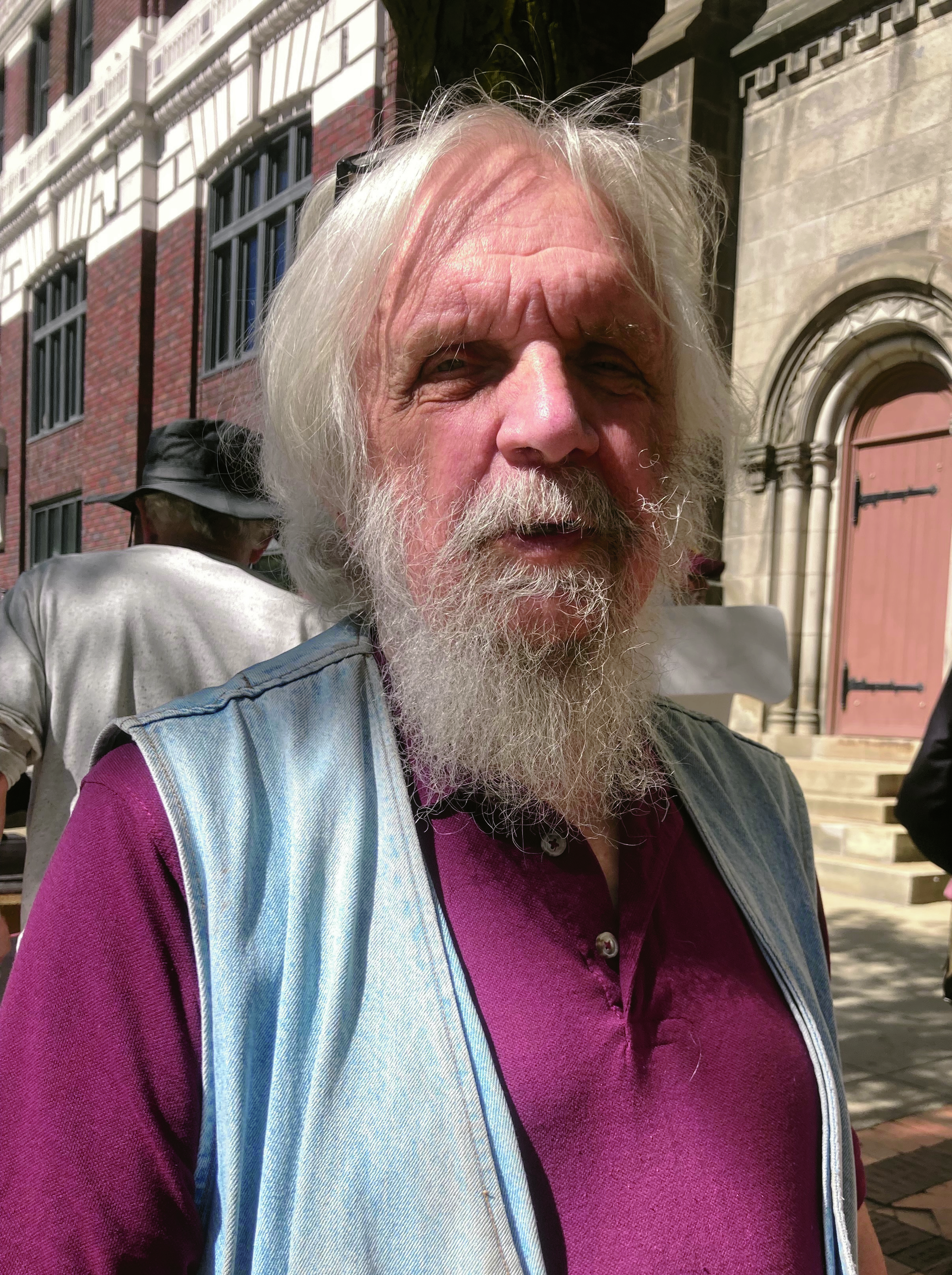
Monday, September 14, 2026; Repairers of the Breach’s Moral Monday Protest, Cleveland Public Square: Repairers of the Breach member Tim Walters urges Clevelanders concerned about moral issues to come out and vote in the November election.
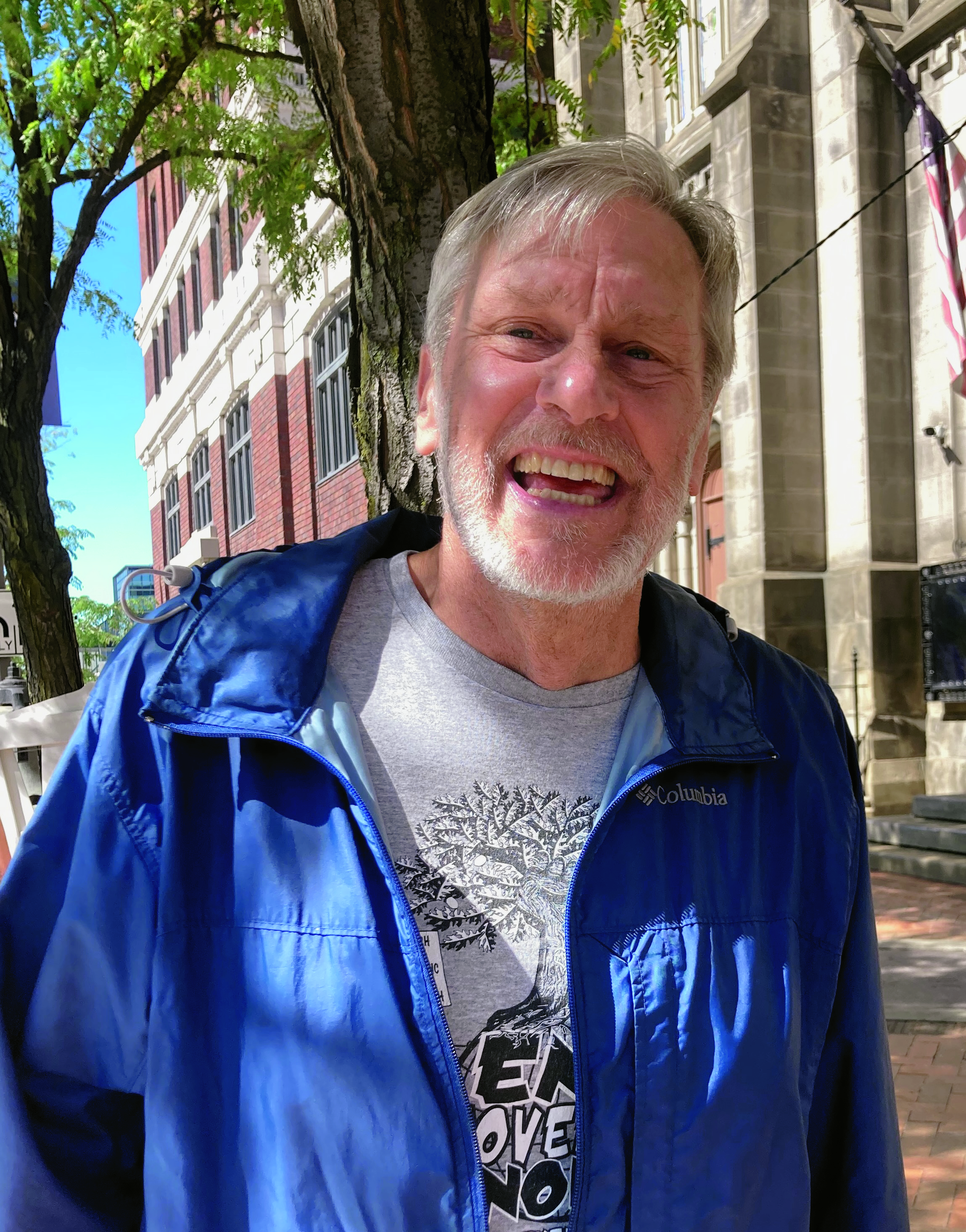
PHOTO BY BRUCE CHECEFSKY
Monday, September 14, 2026; Repairers of the Breach’s Moral Monday Protest, Cleveland Public Square: Repairers of the Breach member Duane Drotar stressed the importance of voting, and expressed concern of the impact of President Trump’s One Big Beautiful Bill on friends and family members who can no longer afford healthcare.
by Bruce Checefsky
(Plain Press October 2026) Rev. Doug Horner fumbled with a megaphone while protesters gathered in front of the Old Stone Church in downtown Cleveland. He was there to lead the Repairers of the Breach Moral Mondays March from Public Square to the federal government office tower on Lakeside Avenue, just a few blocks away.
Once the megaphone was working, he said, “How is everyone? You’re a small but mighty group!”
Rev. Horner, a prominent retired United Church of Christ (UCC) pastor, community activist, and advocate for the unhoused, is best known for his long-term tenure as the senior pastor of St. Paul’s Community UCC in the Ohio City neighborhood, and he reminded people why they were there.
Repairers of the Breach is a national moral advocacy nonprofit founded in 2015 by the Rev. Dr. William J. Barber II and based in North Carolina, with a mission to combat systemic poverty, racism, ecological devastation, and voter suppression through a “Moral Public Policy Agenda” and the Poor People’s Campaign: A National Call for Moral Revival, working across over 30 states to organize low-wealth communities and faith leaders. The term comes from the Bible and symbolizes rebuilding broken community structures by healing divisions and restoring justice. Moral Mondays is a grassroots protest and civil disobedience movement to hold government officials accountable on issues of human rights and poverty.
After a brief introduction, Rev. Horner began chanting. “Somebody’s been hurting my brother and my sister, and it’s gone on far too long.” Protestors joined in. “Somebody’s been poisoning our water, and it’s gone on far too long, and we won’t stay silent any longer.”
Jenny, from Kirkland, was holding a protest sign. “These times ask us to step forward and speak up for justice for those without a voice, from both an economic and spiritual sense. We are all connected and we have to help each other,” she said, and when asked about the critical voting issues for the midterm election in November, she added, “Health care for all is essential. The total polarization of government and people is a challenge. We have to come together as a country. The 1% of the population are serving themselves and leaving everyone else behind.”
Duane Drotar, from Cleveland, said that Senator Bernie Moreno had not responded to several requests to meet, so protesters took to the streets. “We are going to march to Senator Husted’s office to address voting issues and make an appeal to the importance of voting. President Trump’s One Big Beautiful Bill Act (OBBBA) killed us,” said Drotar. “We have so many friends and family members that can no longer afford health care because the premiums have skyrocketed. For many people, the new work requirements for Medicaid make it hard for them to survive.”
Democrats are more grassroots in their approach, going door to door, he said, while Republicans bombard the airwaves with untruths. “How are they allowed to do that?”
Tim Walters, a contributing writer to the Plain Press, stood next to Rev. Horner, handing out flyers with a headline that read, ‘Your vote makes an enormous difference!’.
“One feature that we pride ourselves on regarding the Moral Mondays March is that, while there is a smaller crowd today than at other times, it shows a significant number of people working together,” said Walters. “We’re going to deliver a letter to Husted’s office today. We don’t expect to see him or get a reply, but our big statement centers on issues of voting.”
Walters said voting issues impact different people differently, with human rights at the top of the list. “We want something better, not back to the way it was.”
Mitchell, from Akron, was in Cleveland for the day. He stood on the sidewalk holding a tombstone sign with ‘Lorenzo Vargas, Age 32, Died in I.C.E. Custody 2025’ stenciled across it.
“I am here supporting Northeast Ohio Coalition for the Homeless (NEOC)” he said, adding that the midterm elections could result in a better power balance in both the Senate and House. “I.C.E. (Immigration and Customs Enforcement) and significant changes to Medicaid restrictions are a huge issue, with money taken from the Supplemental Nutrition Assistance Program (SNAP), and work requirements make it impossible for people unable to work to get food assistance.”
Kathleen McDonnell, from Cleveland’s west side, said gathering with people on a Monday morning in prayer was a wonderful thing to see. “I made over forty phone calls in the past year to my senators to talk about how immigrants are being treated, for example,” she said “I look at the wars we are supporting, and it is grievous. Ignoring and exacerbating the destruction of our environment, gutting human services for people in need, destroying guardrails for democracy, and diminishing voting are equally grievous.”
The protestors chanted as noontime downtown workers piled out of their offices onto the sidewalks and car traffic increased. “No more hunger! No more war! Peace is what we are standing for!” They repeated the protest slogans several times before gathering their signs and heading down Ontario Ave towards the Anthony J. Celebrezze Federal Building.
Walters was carrying a larger-than-life letter “E” along the march route, with others from the group dragging the letters “V,” “O,” and “T” in succession to spell VOTE.
Rev. Horner was using the megaphone to lead them on. “Somebody’s been hurting our people, and it’s gone on far too long,” he shouted. “Somebody’s been poisoning our water, and it’s gone on far too long, gone on far too long, and we won’t stay silent any longer,” he repeated. “Somebody’s been hurting our children, and it’s gone on for too long, and we won’t be silent any longer.”
Protestors are out every second Monday at noon, he said, while taking a break but keeping stride with the marchers. “We are tired of our legislators and senators not listening to us. Finally, this week, we have a meeting with an aide to Senator Husted.”
“We will be cordial and talk about not what he has done wrong but what he has done right, and mention that we want to work with him moving forward on the issues,” he added.
“Whether he wins or loses this race, we need to work together against policy issues that are hurting our brothers and sisters.” He paused and looked around. “We want to cause no harm. It is that simple. We are supposed to help the weakest link in our society as part of our heritage and tradition.”
The march continued along Ontario St., onto Lakeside Ave. E, ending at E. 9th Street, then disappearing inside the federal building. Senator Husted’s office did not respond to a request for comment.
Ohio general midterm elections take place on November 3, 2026, with polls open from 6:30 a.m. to 7:30 p.m. The voter registration deadline is October 5. Mail-in voting begins on October 6. Early in-person voting is from October 6 through November 1.
The ballot includes one U.S. Senate seat and all 15 U.S. House of Representatives seats, along with the governor, lieutenant governor, attorney general, secretary of state, auditor, and treasurer. The Ohio Senate has 17 seats open, with 99 seats in the Ohio House of Representatives, two Ohio Supreme Court justices, and multiple intermediate appellate and municipal judges all subject to the judgement of voters.
State Issue 3 is a proposed constitutional amendment to make the state’s voter photo ID requirement a constitutional mandate. A “yes” vote supports amending the state constitution to require a government-issued photo ID for voting permanently. A “no” vote does not eliminate Ohio’s existing photo ID requirement for voting, which has been state law since 2023.


Leave a comment